Pope Leo XIV Calls the Popemobile an Instrument of Encounter as Vatican Exhibition Opens Today
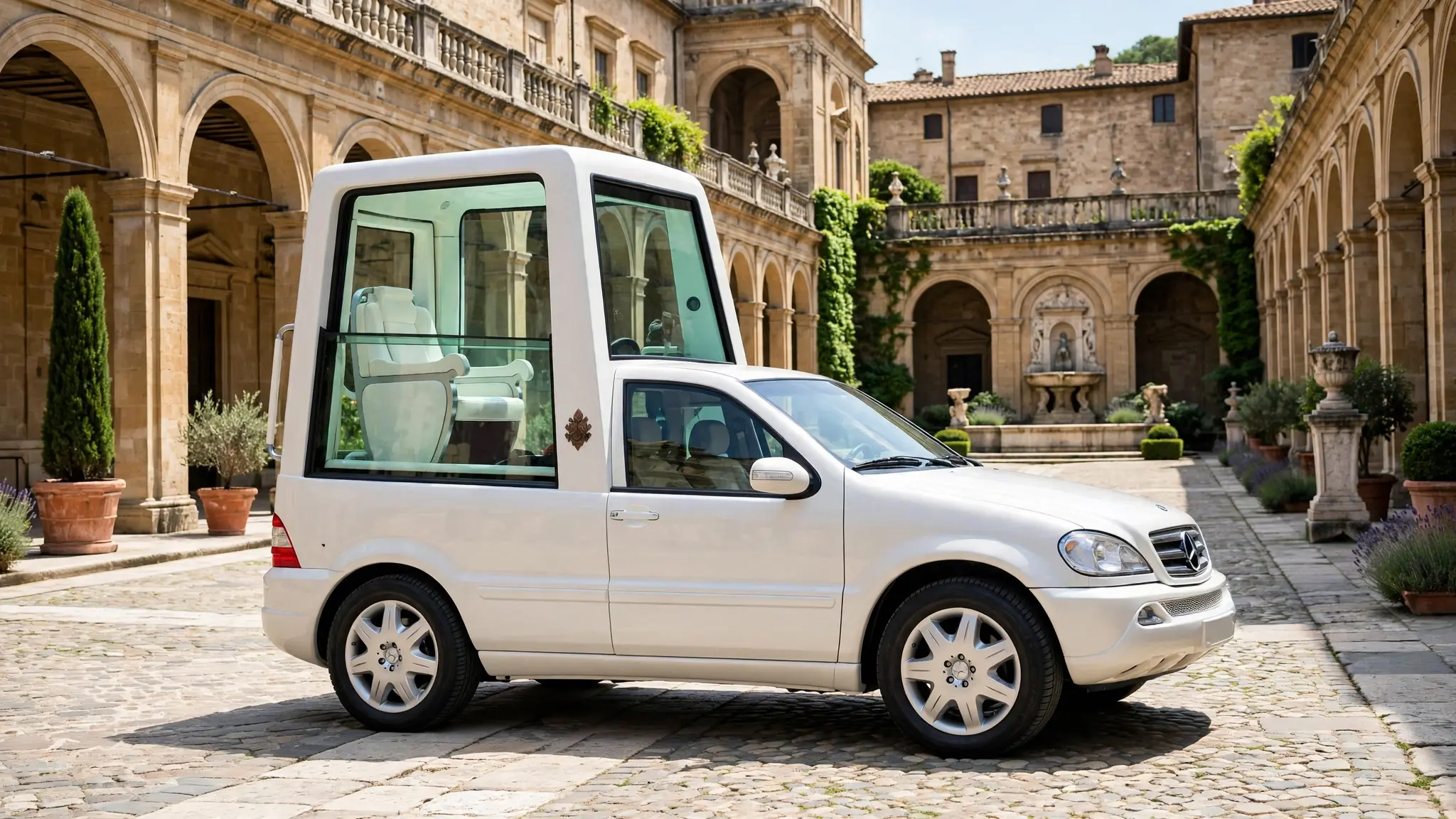
Marc Langenbrinck will remember 28 October 2026 as the best day of his working life. The chief executive of Mercedes-Benz Italy stood in the Apostolic Palace, met the Pope, and said it was the most beautiful day of his career because he is Catholic.
On 28 October, Pope Leo XIV recieved executives from Mercedes-Benz in a private audience at the Apostolic Palace, as reported by CathoNews. The meeting marked nearly 100 years of the German manufacturer building vehicles for the popes, and on that same day the Vatican Museums opened the exhibition "A Century of the Popemobile" in its Square Garden.
The exhibition opens to the public on Thursday 29 October and runs through 31 January 2027, according to the Vatican State announcement. Eight historic vehicles trace the evolution of the popemobile, joined by a reproduction of the 1886 Benz Patent-Motorwagen and a contemporary Mercedes-Benz S-Class.
The popemobile has become an instrument of encounter, enabling the pontiff to draw closer to the faithful.
That sentence reframes the cars completely. They are not there to impress, but to remind everyone watching that the vehicle exists so the pontiff can draw closer to the faithful.
A Century of the Popemobile: From the 1930 Nürburg to the Electric G 580
The story starts in black, not white. First on display is the Nürburg 460, a shiny black Pullman limousine delivered to Pope Pius XI in 1930, with a plush papal seat covered in raspberry silk brocade, as described in the AFP coverage carried by Gulf News and Malay Mail.
That car became the first automobile to be used regularly by a pope, according to the Vatican State announcement, which dates the relationship between Mercedes-Benz and the Vatican to 1930. Over the decades that followed, official state limousines and landaulets gave way to specially built off-road vehicles, each one answering a different question about how a pope should travel among crowds.
A 1960 Mercedes-Benz 300 d Pullman Landaulet, built for Pope John XXIII, shows a different answer again. Its removable window panels allowed the pope to interact more directly with people gathered along his route.
Pope Leo XIV Popemobile: The 1980 Design That Changed Everything
The vehicle most visitors will recognise arrived in 1980. For Pope John Paul II's visit to Germany, Mercedes-Benz built a vehicle with an elevated seating position, a transparent dome, and pearlescent paintwork, based on the G-Class introduced the previous year, according to the Vatican State announcement.
That design changed what a crowd could see, and what a pope could see in return. The aim, the announcement says, was to ensure the pope was clearly visible during public events while still allowing direct contact with the people.
Sandro Barbagallo, head of the Vatican Museums' department of historical collections, told journalists at a preview that the popemobile should not be viewed as just a simple means of transport.
The so-called popemobile serves to allow people to see the pope, but also to allow him to see. It serves so that people can greet the pope, but also and above all so that the pope can, along the roads, greet and at the same time bless.
Barbagallo added that it is modern technology placed at the service of the pontiff and his ministry. The 1997 lungo Landaulet with an electrohydraulic soft top, built for John Paul II, and the ML 500 made for Pope Benedict XVI in 2012, with an enlarged enclosed back section for optimal viewing, make the same argument in steel and glass.
The newest chapter is electric. Since 2024, the Vatican has had its first fully electric popemobile, a specially configured Mercedes-Benz G 580.
Mercedes-Benz Pope Seat: Even the Boss Cannot Sit There
Marcus Breitschwerdt, an executive vice president of Mercedes-Benz, explained one rule that surprises almost everyone who hears it. No Mercedes-Benz employee, including the chief executive, is permitted to sit in the pope's seat, as CathoNews reported from the audience.
He pointed to the armoured construction and secured glass of the vehicles, designed to protect the Holy Father in dense crowds while keeping him visible to the faithful. The glass itself tells a story: popemobiles have included bulletproof glass since the assassination attempt on John Paul II in 1981, as AFP noted, and the tension between protection and closeness has never quite gone away.
Pope Francis felt that tension sharply. He told a Spanish newspaper in 2014 that he could not get close to the people from within his "sardine can" popemobile encased in bulletproof glass, AFP reported, and for short trips across Rome he often opted for a simple white Fiat instead. That tension is the real subject of the exhibition, and it is why Pope Leo's phrase matters.
For more on Pope Leo's recent public ministry, see the report of France recording more than 13,000 adult baptisms as Pope Leo visited Paris and the Gen Z Catholic revival story, in which the Vatican urged caution as France baptisms jumped 26 percent, as well as Jonathan Roumie's explanation of why he wears skull rings almost every day.
For Langenbrinck, the day ended with a sentence that had nothing to do with cars. He called it the most beautiful day of his career because he is Catholic.
Will visitors leave thinking about engines and upholstery, or about the question Barbagallo posed at the preview: whether a machine can ever truly serve an encounter, and what the next century of popemobiles will have to answer?
Frequently Asked Questions
On 28 October 2026, as reported by CathoNews, Pope Leo XIV told Mercedes-Benz executives that the popemobile has become an instrument of encounter, enabling the pontiff to draw closer to the faithful, and he encouraged technological innovation at the service of human dignity, care for creation, and the common good.
It is an exhibition at the Vatican Museums in the Square Garden, opening to the public on 29 October 2026 and running to 31 January 2027, showing eight historic Mercedes-Benz vehicles tracing papal transport from 1930, plus a reproduction of the 1886 Benz Patent-Motorwagen and a contemporary S-Class.
The 1930 Mercedes-Benz Nürburg 460 Pullman limousine delivered to Pope Pius XI became the first automobile used regularly by a pope, according to the Vatican State announcement; the first modern popemobile design, with an elevated seat and transparent dome, was built for John Paul II in 1980.
No. Mercedes-Benz executive vice president Marcus Breitschwerdt explained, as reported by CathoNews, that no Mercedes-Benz employee, including the chief executive, is permitted to sit in the pope's seat.
Yes. Since 2024 the Vatican has had its first fully electric popemobile, a specially configured Mercedes-Benz G 580, according to the Vatican State announcement.
🔔 Don't Miss the Next Story!
Get breaking Christian news on your phone before everyone else — allow notifications when prompted, or join our newsletter below!
But the most surprising part of this story is yet to come — keep reading.
🙏 Have a Testimony to Share?
Has God done something amazing in your life? Or want us to cover a specific story? Send your testimony or story request via WhatsApp — your story could encourage thousands!
💬 Comments
Share your thoughts below. Be kind and respectful. If this story touched you, let us know in the comments!