No Revival in Britain as Church Attendance Stays Low
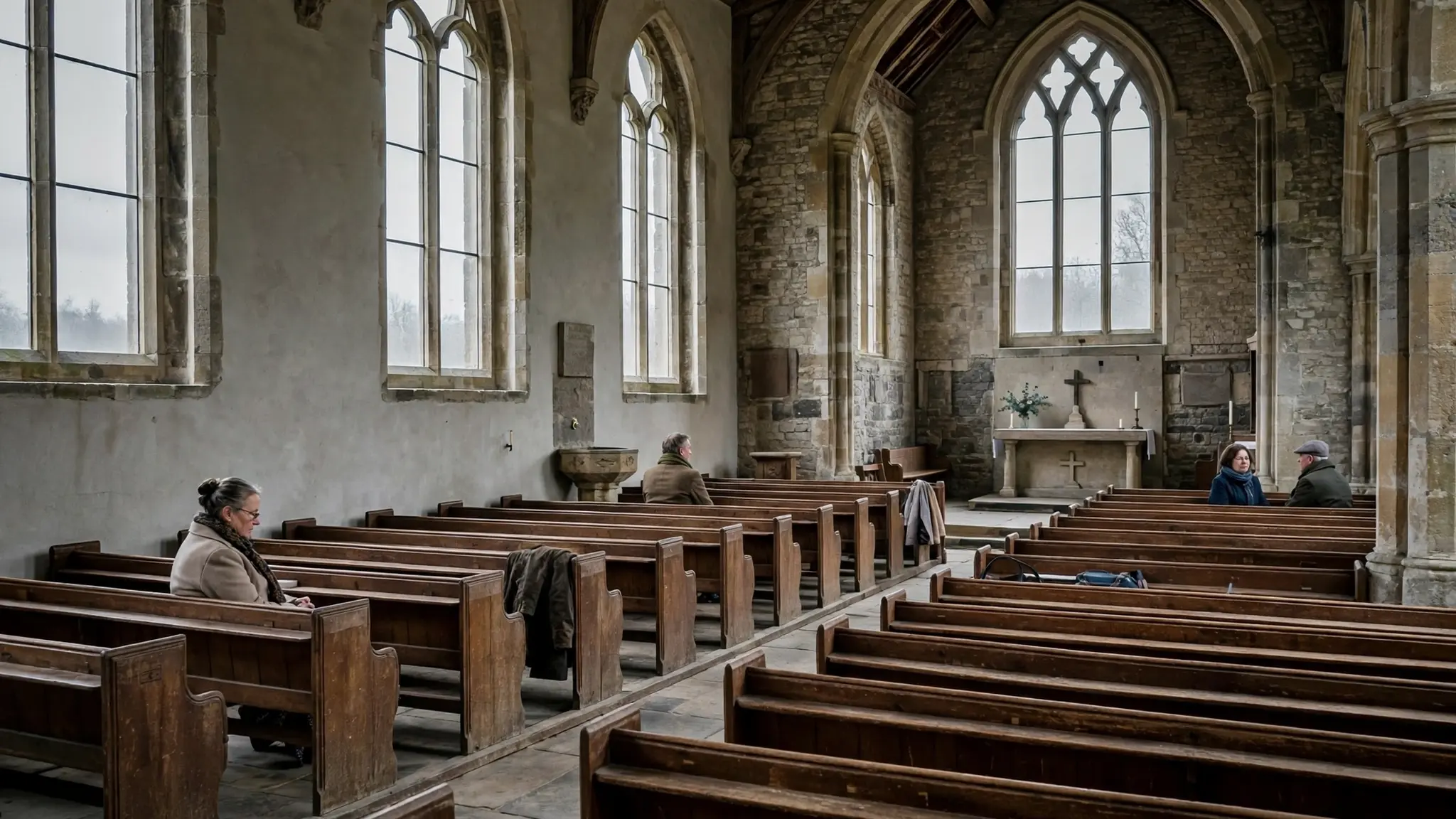
There is no revival in church attendance in Britain. New findings from the British Social Attitudes survey confirm that attendance among Christians has not recovered to pre-pandemic levels, and that younger people show no sign of leading a religious renewal.
Just one in eight Christians, 13%, say they attend a religious service at least once a week. That is the same figure reported from the 2024 survey, close to the 12% recorded during the pandemic in 2021, and well below the 20% recorded in 2018, before Covid.
Only 5% of all British adults now attend a Christian service weekly, down from 8% in 2018. The pews are not filling again. They are, quietly, still emptying.
The numbers come from the 2026 British Social Attitudes survey, conducted in autumn 2025 by the National Centre for Social Research. The survey has run continously since 1983 and is widely regarded as the gold standard for tracking public opinion in Britain, built on probability-based random sampling rather than online opt-in panels.
Young People Are Not Leading a Revival
The sharpest finding concerns the young. Just 4% of those aged under 35 attend a Christian service at least once a week, in line with the 3% to 5% recorded since 2017. There is no evidence of a recent increase.
Only a quarter of under-35s, 25%, identify as Christian at all, compared with 52% of those aged 55 and over. And among under-35s who do identify as Christian, monthly attendance stands at 26%, well below the 36% average recorded in the three years before the pandemic.
It is true that Christians aged 18 to 34 are slightly more likely than those aged 55 and over to say they attend a service at least once a month. But that pattern has existed since well before the pandemic. It is not new, and it is not a revival.
The survey also found that weekly attendance among those aged 70 and over has halved since 2017, from 18% to 9%. That matters because it changes how the numbers look. If congregations appear younger, the data suggest it is because older worshippers have stopped coming, not because younger ones have arrived.
"The evidence from the British Social Attitudes survey is clear: there has been no revival in Christian observance in Britain," said Sir John Curtice. "Church attendance remains below pre-pandemic levels across all age groups, and the suggestion that younger people are leading a religious renewal is not borne out by the data."
The Quiet Revival That Wasn't
These findings land directly on one of the biggest religion stories of recent years. The Bible Society's "Quiet Revival" report, published last year on the basis of YouGov research, claimed that Christian church attendance, particularly among younger people, was rising. It attracted widespread media coverage.
Shortly before Easter this year, YouGov stated the research was flawed due to fraudulent survey responses. The Bible Society subsequently withdrew the report. The latest British Social Attitudes data confirm the earlier finding that there is no evidence of a Christian revival among younger people in Britain.
Non-Christian religious attendance, which appeared in the 2024 survey to have recovered to pre-pandemic levels, has fallen back again in the latest data. Sir John Curtice said Covid-19 appears to have had a more lasting effect on religious practice in Britain than many had hoped, and that the effect extends beyond Christianity to other faith communities too.
What the Numbers Cannot See
A national survey measures behaviour, not hearts. It counts who sits in a pew on a Sunday. It cannot see the person praying at home or the seeker who has not yet walked through a church door.
That is why the same week can hold two different stories. Msgr John Armitage says 22 people joined RCIA in his East London parish, as reported in John Armitage Sees England's Third Spring of Faith, and the Revival Centre in Papua New Guinea marked 40 years with 374 baptisms, as covered in Revival Centre PNG Marks 40 Years With 374 Baptisms. Individual churches can be growing while the national picture falls, and both facts can be true at once.
Franni Cash found Jesus' grace after leaving a cult, as reported in Franni Cash Finds Jesus' Grace After Leaving Cult, and John Shaver released a testimony-driven gospel album, as covered in John Shaver Releases Change in My Life Album. These are real conversions, real baptisms, real songs. They simply do not add up to a national revival yet.
The honest response is not to dismiss the small flames, nor to pretend they are a wildfire. It is to tend them, count them truthfully, and ask what would have to change for the numbers to move.
A Sobering Picture for the Church
For church leaders, the survey is a cold splash of water. The pandemic did not pause British Christianity and then release it unchanged. It broke habits that have not re-formed, and younger adults have not replaced the older worshippers who stayed away.
Monthly attendance has fallen across all age groups since 2017. There is no bounce, no surge, no hidden wave waiting in the figures.
The question the data leaves behind is the one every empty pew asks on a Sunday morning. What will bring people back, and who will go out and find them?
The answer, if it comes, will show up first in places no survey can reach, and only later in numbers like these.
Frequently Asked Questions
The 2026 survey found just 13% of Christians attend weekly, the same as in 2024 and well below the 20% of 2018. Only 5% of all British adults attend weekly, down from 8% in 2018.
No, according to the survey. Just 4% of under-35s attend a Christian service weekly, in line with the 3% to 5% recorded since 2017. Only 25% of under-35s identify as Christian, compared with 52% of those aged 55 and over.
The Bible Society withdrew its Quiet Revival report after YouGov said the research was flawed due to fraudulent survey responses. The British Social Attitudes data confirm there is no evidence of a Christian revival among younger people in Britain.
Weekly attendance among those aged 70 and over has halved since 2017, from 18% to 9%. The survey suggests congregations look younger because older worshippers have stopped attending, not because of an influx of younger ones.
The British Social Attitudes survey has run continuously since 1983 and is conducted by the National Centre for Social Research. It is considered the gold standard for tracking public opinion in Britain. The latest findings come from the 2026 survey, conducted in autumn 2025.
🔔 Don't Miss the Next Story!
Get breaking Christian news on your phone before everyone else — allow notifications when prompted, or join our newsletter below!
But the most surprising part of this story is yet to come — keep reading.
🙏 Have a Testimony to Share?
Has God done something amazing in your life? Or want us to cover a specific story? Send your testimony or story request via WhatsApp — your story could encourage thousands!
💬 Comments
Share your thoughts below. Be kind and respectful. If this story touched you, let us know in the comments!