🎧 Listen to This Story (Audio Mode)
Saved for offline reading — text only; photos need the internet.
Jordan Sentences 3 to Death for Karak Church Funeral Attack That Killed 9
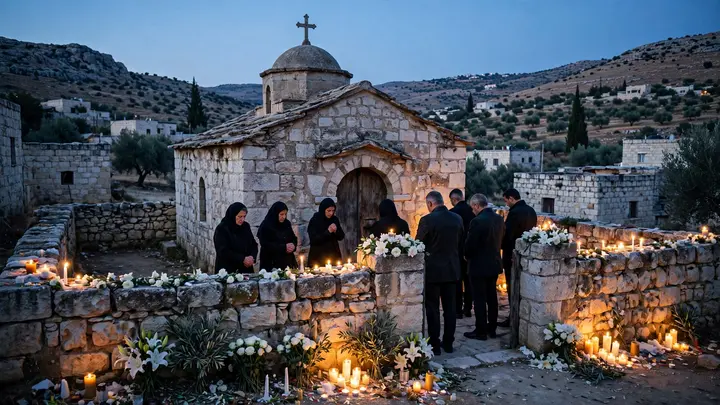
Jordan's State Security Court sentenced three men to death by hanging on Sunday 15 November 2026 for the armed attack on mourners at a funeral at St George's Greek Orthodox Church in Hammoud village, in the Karak governorate of southern Jordan. Nine people were killed and 25 wounded in the attack on Friday 23 October 2026. The three were convicted of carrying out terrorist acts resulting in death, weapons offences, conspiracy to commit terrorist acts, and promoting the ideas of a terrorist organisation.
It was a funeral. The mourners had gathered to bury one of their own, and the gunmen opened fire on them inside the churchyard. That is the fact that has stayed with people in Jordan ever since — that the attack came at the most defenceless moment a community can have, when it is already grieving. Nine families buried their dead that week. Twenty-five more people carried wounds home.
Among the nine slain was Maher Zreiqat. His daughter Mereal posted a tribute photo of her father after his death — a father killed at a funeral, mourned in public by the daughter who had already lost him once in her heart and now lost him for good. His name is the one to hold on to, because the numbers alone do not tell the story. Nine is a statistic. Maher Zreiqat is a man who went to a funeral and never came home.
Print it, pray through it, and share it with your family or small group.
The three convicted men are two Jordanian brothers and their brother-in-law. One of them was also convicted of providing funds to finance terrorist acts. Two further defendants recieved six-year prison terms; according to Amer Halaseh, the lawyer for the victims' families, one of the charges was reclassified and related to selling the weapons used in the attack.
Security forces arrested the three on 26 October, three days after the attack, after a shootout at an abandoned house in Karak. Prosecutors charged them on 3 November with seven offences, and the trial began the next day, 4 November. The speed of the proceedings has itself become part of the argument about the case.
Karak Church Funeral Attack: Death Sentences Not Yet Final
The death sentences are not yet final. Under Jordanian law they face automatic review by the Court of Cassation, with a mandatory appeal within 30 days. That matters, because it means the courtroom story is not over — and because the reactions to the sentences have been mixed from the start.
Religious leaders welcomed the sentences. Others criticised the way the trial was conducted. The death sentences also face opposition from two very different directions: hardline Islamists on one side, and the European Union — one of Jordan's largest donors — on the other. The divide shows how hard it is to find a verdict that satisfies everyone when a crime has cut this deep into a small community.
Former State Security Court judge Amer Halaseh, who also acted as counsel for the victims' families, said he was proud of the statement the court made before announcing the sentence. For the families, the court's words mattered as much as its verdict — a public recognition, in the courtroom, of what had been done to them.
"I was proud of the statement made by the court prior to announcing the sentence."
There is one more fact that has haunted the case. The leader among the three convicted killers had been released before the shooting after years imprisoned for Muslim extremist violence. That detail raises a question no sentence can answer: how did a man with that record walk free, and what failed between his release and the morning of 23 October?
Jordan Christians After Karak: A Rare Attack on a Small Community
The attack was rare. Jordan's Christian community is small, and the country has long been seen as one of the safer places for Christians in the Middle East. That is what made the shooting at St George's so shocking — not only the deaths, but the place. A funeral, in a village church, in a country where Christians and Muslims have lived side by side for generations.
Churches cancelled Christmas festivities for the slain, and condemnation came from across the churches. The grief was not confined to Karak. It reached every congregation in Jordan that understood, in an instant, that it could have been their funeral, their village, their father.
Violence against Christians has scarred the wider region this year. In Nigeria, fourteen Christians were killed in fresh attacks in Plateau State, as reported in Today: 14 Christians Killed in Fresh Plateau State Attacks in Nigeria. In Syria, Melkite Bishop Abdo Arbach was attacked in Homs as patriarchs condemned violence against Christians, as reported in Latest: Melkite Bishop Abdo Arbach Attacked in Homs as Syria Patriarchs Condemn Violence Against Christians. And in Pakistan, the Supreme Court confirmed a death sentence for a Christian in a blasphemy case, as reported in Pakistan Supreme Court Confirms Death Sentence for Christian Qaiser Ayub in Blasphemy Case. Jordan's case is different in its facts, but it belongs to the same hard year for the region's Christians.
🙏 Did this part inspire you?
Inside Jordan, the wound is also a test of the country's own story about itself. A nation that prides itself on coexistence now has nine graves in Karak to explain. The court's sentence is one answer. The automatic review will be another. And the families — the Zreiqats and the others — will live with the loss long after both are done.
The next chapter belongs to the Court of Cassation. Within 30 days, the judges there must review the sentences automatically, and their decision will decide whether the three men live or die. Until then, the families wait — and the church in Hammoud village, where a funeral became a massacre, stands as a reminder of what was lost on a Friday morning in October.
Frequently asked questions
On Friday 23 October 2026, gunmen attacked mourners at a funeral at St George's Greek Orthodox Church in Hammoud village, Karak governorate, southern Jordan. Nine people were killed and 25 wounded. Some reports put the wounded figure higher, at 34, but Al Jazeera and UCA News report 25.
On Sunday 15 November 2026, Jordan's State Security Court sentenced three men to death by hanging — two Jordanian brothers and their brother-in-law. They were convicted of carrying out terrorist acts resulting in death, weapons offences, conspiracy to commit terrorist acts, and promoting the ideas of a terrorist organisation. One was also convicted of financing terrorist acts.
No. The death sentences are subject to automatic review by the Jordanian Court of Cassation, with a mandatory appeal within 30 days. Two further defendants received six-year prison terms.
Maher Zreiqat was one of the nine people killed in the attack on the funeral at St George's Greek Orthodox Church in Karak. His daughter Mereal Zreiqat posted a tribute photo of her father after his death. Churches cancelled Christmas festivities for the slain.
Security forces arrested the three men on 26 October 2026, three days after the attack, after a shootout at an abandoned house in Karak. Prosecutors charged them on 3 November with seven offences, and the trial began on 4 November.
🙏 Did this part inspire you?
Print it, pray through it, and share it with your family or small group.
🔔 Don't Miss the Next Story!
Get breaking Christian news on your phone before everyone else — allow notifications when prompted, or join our newsletter below!
But the most surprising part of this story is yet to come — keep reading.
🙏 Have a Testimony to Share?
Has God done something amazing in your life? Or want us to cover a specific story? Send your testimony or story request via WhatsApp — your story could encourage thousands!
💬 Comments
Share your thoughts below. Be kind and respectful. If this story touched you, let us know in the comments!