🎧 Listen to This Story (Audio Mode)
Saved for offline reading — text only; photos need the internet.
Today: Egyptian Christian Convert Said Abdelrazek Faces Death Penalty as US Monitors Trial
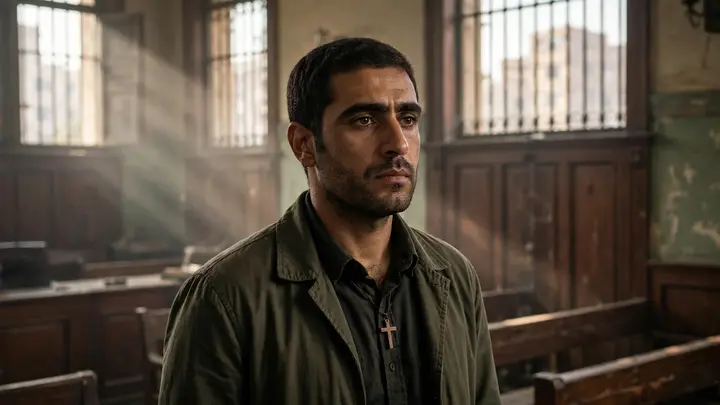
Said Mansour Rezk Abdelrazek, an Egyptian who converted from Islam to Christianity in 2016, faces the death penalty or 25 years in prison. He was arrested at his home in Cairo's Matariya neighbourhood on 15 July 2025 after asking for his official identity papers to record his Christian faith. He has now spent more than a year in custody, and the US State Department says it is monitoring his trial closely.
Think about what he actually did. He did not organise a protest. He did not publish a book attacking anyone's beliefs. He asked the Egyptian state to write one true word on his identity card — Christian. For that request, he now stands before the Terrorism Circuit of the First Criminal Court in Badr, charged with offences that carry the ultimate punishment.
Abdelrazek spent nine months in arbitrary pretrial detention before his case was referred to the terrorism court. He is now held in 10th of Ramadan Prison. His first hearing was in April 2026, and a hearing on 3 November drew concern over reported religious remarks attributed to the judge. In early November, the Public Prosecution presented its closing arguments and asked for the maximum penalty prescribed by law. The defence will present its closing arguments on 8 December 2026.
Print it, pray through it, and share it with your family or small group.
The charges against him are prosecution allegations — not findings of guilt, and they must be reported as such. He is accused of joining a banned terrorist organisation, contempt for Islam, inciting unrest, and spreading false information. His lawyer, Said Fayez, says the terrorism charge is fabricated: the real issue is a man who converted to Christianity in 2016 and will not pretend otherwise. No court has found him guilty of any of these charges.
"We are monitoring his trial closely."
That sentence, from a US State Department spokesperson, is the most important one in this story so far. The United States has intensified its pressure on Egypt to respect religious liberty. Egypt receives $1.3 billion in annual US funding, according to Coptic Solidarity and Fox News Digital — and that money gives Washington leverage it is now being asked to use.
His fiancée Sophia — her surname withheld, an Australian-Egyptian dual citizen — has become the public voice of the campaign to save him. She has appealed to the Netherlands and the United States, including asking the Dutch government to consider trading him for Ahmed Nasser, a man Egypt has pressed to free. She has urged the US to make its roughly $1.5 billion in annual aid conditional on his release and on better treatment of religious minorities. More than 35,000 people have signed Coptic Solidarity's petition for his release.
Said Abdelrazek Egypt Trial: A Convert Who Asked His ID Card to Say Christian
Amnesty International has called for Abdelrazek's immediate and unconditional release, saying he is jailed only for peacefully living out his faith. Coptic Solidarity calls the trial "a defining test for the future of religious freedom in Egypt". Both organisations are saying, in different words, the same thing: this is not really a terrorism trial. Christians in Syria have made the same plea, as their patriarchs condemned violence against Christians, as reported in Latest: Melkite Bishop Abdo Arbach Attacked in Homs as Syria Patriarchs Condemn Violence Against Christians.
Christians facing the death penalty for their faith are, tragically, not a new story.
The case sits inside a much bigger argument about religious freedom in Egypt. Christians there have long faced pressure — from bureaucratic obstacles to violence — and converts from Islam face the sharpest edge of it. Changing the religion on an identity card sounds like paperwork, but in Egypt it is one of the hardest things a person can ask for. The card follows you everywhere: to jobs, to schools, to hospitals, to marriage.
That is what makes Abdelrazek's story so hard to look away from. He is not a public figure or an activist with a platform. He is an ordinary man who made a private decision of faith ten years ago and then asked for the paperwork to match. The price of that honesty may now be his life — or 25 years of it behind bars. But the decision will be made in a courtroom in Badr, and the world can only watch.
The timing matters. The defence's closing arguments come on 8 December, less than three weeks from now. Between now and then, the pressure on Egypt is likely to grow — from Washington, from human rights groups, from churches around the world. Whether that pressure changes anything will depend on how much Egypt values its relationship with the United States.
This is not the first time Egypt's treatment of Christians has drawn international attention. A US hearing on Egypt recently demanded the repeal of the country's blasphemy laws. But a hearing is about a law. This is about a man — a man in a prison cell, waiting to hear whether he will live or die for the word on his identity card. The two stories are connected, but they are not the same question.
🙏 Did this part inspire you?
Christian Convert Death Penalty Egypt: US Pressure and Sophia's Plea
Christians facing the death penalty for their faith are, tragically, not a new story. In Pakistan, the Supreme Court recently confirmed a death sentence for a Christian man in a blasphemy case, as reported in Pakistan Supreme Court Confirms Death Sentence for Christian Qaiser Ayub in Blasphemy Case. And Catholic bishops have warned that Christians are under threat in Sudan as war destroys their churches, as reported in Today: Catholic Bishops Warn Christians Under Threat in Sudan as War Destroys Churches. Abdelrazek's case belongs in that grim company.
There is also a wider pattern here that Christians in the West sometimes miss. Persecution is not always carried out with bombs and guns. Sometimes it is carried out with paperwork — with a refused identity card, a stalled court case, a charge that turns a believer into a "terrorist" on paper. The violence is quieter, but the result is the same: a person punished for what they beleive.
For Sophia, the waiting is its own kind of suffering. She has appealed to two governments and watched a petition grow past 35,000 names — all while the man she hopes to marry sits in prison. Her plea is simple: make the aid conditional, make the pressure real, and do not let the world look away. It is the plea of someone who knows that attention is the only protection her fiancé has right now.
The question hanging over the 8 December hearing is whether attention will be enough. The US is watching. The petition is growing. The defence will make its case. But the prosecution has already asked for the maximum penalty, and the court has already heard months of argument in a terrorism court. For a man whose real offence was asking for an honest identity card, that is a terrifying place to stand.
What happens next will tell the world something important about Egypt — and about the world itself. If Abdelrazek is freed, it will show that international pressure, honestly applied, can still save a life. If he is sentenced to death or to 25 years, it will show that a man can still be destroyed in 2026 for the crime of changing his faith and saying so. Either way, the answer comes on 8 December, in a courtroom in Badr.
Frequently asked questions
Said Mansour Rezk Abdelrazek is an Egyptian who converted from Islam to Christianity in 2016. He was arrested at his home in Cairo's Matariya neighbourhood on 15 July 2025 after seeking to have his official identity papers record his Christian faith. He is held in 10th of Ramadan Prison.
He faces prosecution allegations — not findings of guilt — of joining a banned terrorist organisation, contempt for Islam, inciting unrest, and spreading false information. His lawyer, Said Fayez, says the terrorism charge is made up and the real issue is Abdelrazek's refusal to deny his Christian faith.
Abdelrazek faces the death penalty or a 25-year prison term. In early November 2026, the Public Prosecution presented closing arguments and asked for the maximum penalty prescribed by law. The defence presents its closing arguments on 8 December 2026.
A US State Department spokesperson said: "We are monitoring his trial closely." The US has intensified pressure on Egypt to respect religious liberty. Egypt receives $1.3 billion in annual US funding, and Abdelrazek's fiancée Sophia has urged Washington to make its roughly $1.5 billion in annual aid conditional on his release.
Sophia, Abdelrazek's fiancée and an Australian-Egyptian dual citizen, has appealed to the Netherlands and the United States to save him, including asking the Dutch government to consider trading him for Ahmed Nasser. More than 35,000 people have signed Coptic Solidarity's petition for his release, and Amnesty International has called for his immediate and unconditional release.
🙏 Did this part inspire you?
Print it, pray through it, and share it with your family or small group.
🔔 Don't Miss the Next Story!
Get breaking Christian news on your phone before everyone else — allow notifications when prompted, or join our newsletter below!
But the most surprising part of this story is yet to come — keep reading.
🙏 Have a Testimony to Share?
Has God done something amazing in your life? Or want us to cover a specific story? Send your testimony or story request via WhatsApp — your story could encourage thousands!
💬 Comments
Share your thoughts below. Be kind and respectful. If this story touched you, let us know in the comments!