🎧 Listen to This Story (Audio Mode)
Saved for offline reading — text only; photos need the internet.
King Charles Tells Church of England to Serve Everyone as Society Feels Divided
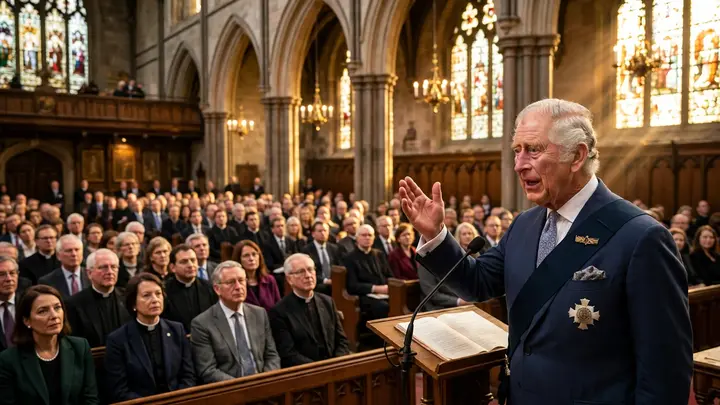
King Charles told the Church of England on Tuesday 17 November 2026 that it must serve everyone in the country — not just its own members — at a time when society feels divided. Speaking to nearly 500 members of the new General Synod at Church House in London, he said the Church protects not just the Christian faith but "the very space for faith itself — of every belief — within our whole society and national discourse".
The day began quietly, before the speeches. The King attended Holy Communion at Westminster Abbey, where he knelt to recieve Communion from the Archbishop of Canterbury, Sarah Mullally. It was a striking image: the Supreme Governor of the Church of England kneeling to take bread and wine from the woman who now leads it. The Synod that followed is the first of his reign, and the first under Archbishop Mullally.
Charles spoke about his own faith in unusually personal terms. He said his Christian faith has "developed and deepened across the decades of my life", calling it "the sustenance which nurtures and the compass which guides my every act as Sovereign". He said he followed "in the footsteps of my late mother", Queen Elizabeth II, who attended no fewer than 10 Synod openings during her reign.
Print it, pray through it, and share it with your family or small group.
Then came the heart of his message. "At a time when our society can feel divided," he told the 487 Synod members, "it is all the more important that the Church of England continues to extend its ministry among all the people of this country." The line was the centrepiece of the address — a direct instruction to a church that sometimes turns inward, to keep its doors and its ministry open to everyone, whatever they believe.
"At a time when our society can feel divided, it is all the more important that the Church of England continues to extend its ministry among all the people of this country."
He went further, describing faith itself as a "wellspring for social cohesion" where many faiths might flourish. In a world "too often marked by uncertainty and anxiety", he said, mercy, patience and humility "remain as vital and compelling today as ever". It was a vision of the Church not as a fortress for the faithful, but as a shared space — a place where the whole country, Christian or not, can find room to breathe.
The King also knew his audience would argue. Synod debates, he said, "will no doubt involve differing views and strong feelings" — and he urged members to conduct their discussions "imbued with the love of God" and to "put yourself in the shoes of those with whom you disagree". In a church that has spent years arguing over sexuality, safeguarding and money, that advice landed as both gentle and pointed.
King Charles General Synod Address: Faith as a Wellspring for Social Cohesion
He did not forget Christians beyond Britain's shores. The King remembered Christians facing persecution, violence or displacement worldwide, particularly "those ancient Christian communities of the Middle East and the Holy Land", and encouraged deeper ties among Christian traditions. Bishops there have pleaded for the world not to look away, as reported in Latest: Melkite Bishop Abdo Arbach Attacked in Homs as Syria Patriarchs Condemn Violence Against Christians.
Archbishop Mullally, speaking later on Tuesday, echoed the King's warning in even blunter language. She described "a society that is riven by polarisation, hostility, humiliation of the other, and deepening divisions" — a picture of Britain that matched the King's own. But she also turned to the practical pressures on the Church itself, and her message carried a sharper edge than his.
Mullally criticised the government for leaving parishes with an "intolerable burden" by scrapping VAT relief on church repairs. She warned that "too many clergy are struggling; serving multiple parishes, dealing with huge administrative workloads and feeling isolated". It was a plea from the front line: the Church cannot serve everyone if its clergy are exhausted and its buildings are crumbling. She told the King directly: "We welcome you for the first time as our supreme governor, and with gratitude for your lifelong support for our church."
The contrast between the two speeches was telling. The King spoke as a monarch and a believer, offering a vision. The Archbishop spoke as a leader responsible for thousands of parishes, naming the costs. Together they described a church asked to do more — to hold a divided society together — while its own resources shrink.
The Synod session runs Tuesday to Wednesday, with an agenda that includes safeguarding updates, church buildings, funding and clergy wellbeing. They are the unglamorous work of keeping a national church alive: making sure children are safe, roofs do not leak, clergy do not burn out, and parishes can pay their bills.
There was a small piece of history tucked into the day as well. The address at the Abbey service was given by Sister Nathalie Becquart, the first woman appointed to a voting position at the Vatican's Synod of Bishops. Her presence at the heart of an Anglican service, speaking to the King and the Archbishop, was a quiet sign of how far ecumenical friendship has travelled — and how much further the King hopes it can go.
🙏 Did this part inspire you?
Church of England Divided Society: What the King Asked of the New Synod
What made the speech matter was not its ceremony but its timing. Britain feels divided in ways that are hard to ignore — over politics, over identity, over who belongs and who does not. The King named that feeling openly, and then asked the Church to be part of the answer rather than part of the argument.
The Church of England has, in fact, been growing in quiet ways. Attendance has grown for a fifth year in a row, with adult baptisms rising, as reported in Latest: Church of England Attendance Grows Fifth Year in a Row as Adult Baptisms Rise. People are still finding their way into pews, still asking to be baptised, still looking for something the rest of public life does not offer.
There is also a wider lesson here for Christians everywhere. The King's central claim — that a church serves its country best when it serves everyone, and that mercy, patience and humility are not weaknesses but strengths — is a deeply Christian idea that travels well beyond London. Churches in America have heard a similar call, as Archbishop Coakley told the US Catholic bishops in Baltimore, as reported in Latest: Archbishop Coakley Tells US Catholic Bishops to Focus on Mission Not Politics in Baltimore.
Whether the Synod takes the King's advice will be seen in the months ahead. The debates will be sharp — on safeguarding, on money, on the direction of the Church — and the temptation will be to fight them as battles to be won. The King asked for something different: discussions "imbued with the love of God", where each side tries to stand in the other's shoes.
The question the speech leaves behind is the one the King put to the Synod itself. In a society that feels divided, what does it actually look like for a church to serve everyone? Is it open doors, honest debate, and clergy who have time to listen? Or is it something simpler — the willingness to kneel, as the King did at Westminster Abbey, and to recieve grace before offering it to anyone else? The Synod has five years to answer.
Frequently asked questions
King Charles told the Church of England's General Synod on 17 November 2026 that the Church must extend its ministry among all the people of the country at a time when society feels divided. He said the Church protects "the very space for faith itself — of every belief" and called faith a "wellspring for social cohesion", urging members to "put yourself in the shoes of those with whom you disagree".
King Charles opened the new five-year General Synod on Tuesday 17 November 2026 at Church House, London. It was his first Synod opening as King and the first of his reign, and the first under Archbishop of Canterbury Sarah Mullally. The day began with Holy Communion at Westminster Abbey.
The King said his Christian faith has "developed and deepened across the decades of my life", calling it "the sustenance which nurtures and the compass which guides my every act as Sovereign". He said he followed "in the footsteps of my late mother", Queen Elizabeth II, who attended no fewer than 10 Synod openings.
Archbishop Mullally warned of "a society that is riven by polarisation, hostility, humiliation of the other, and deepening divisions". She criticised the government for scrapping VAT relief on church repairs, leaving parishes with an "intolerable burden", and warned that "too many clergy are struggling" with multiple parishes, heavy workloads and isolation.
The Synod session runs Tuesday to Wednesday, with an agenda including safeguarding updates, church buildings, funding and clergy wellbeing. The Synod is the Church of England's governing body, and this is the first session of its new five-year term.
🙏 Did this part inspire you?
Print it, pray through it, and share it with your family or small group.
🔔 Don't Miss the Next Story!
Get breaking Christian news on your phone before everyone else — allow notifications when prompted, or join our newsletter below!
But the most surprising part of this story is yet to come — keep reading.
🙏 Have a Testimony to Share?
Has God done something amazing in your life? Or want us to cover a specific story? Send your testimony or story request via WhatsApp — your story could encourage thousands!
💬 Comments
Share your thoughts below. Be kind and respectful. If this story touched you, let us know in the comments!