Saint Nicholas Relic Destroyed in French Basilica Today
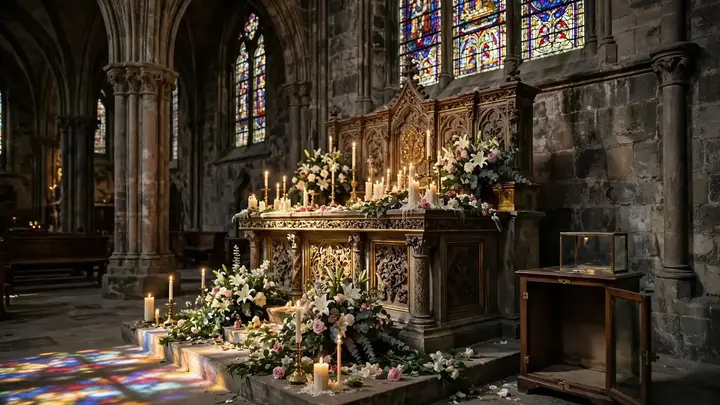
A relic of Saint Nicholas was stolen from the Basilica of Saint-Nicolas-de-Port in northeastern France on November 2, 2026, and police say the arrested suspect admitted burning and crushing it. The suspect told police he acted out of a "desire to destroy" the relic, saying he viewed devotion to the bones as a form of idol worship.
Picture the scene a few weeks before Christmas. The basilica is one of the few sanctuaries in France to hold a relic of the fourth-century bishop who inspired Santa Claus. The priests open the patronal chapel one morning and find the display case broken and the reliquary gone.
A fragment of bone, kept and venerated for generations, has simply vanished into someone's pocket.
What happened at the Basilica of Saint-Nicolas-de-Port?
Priests at the basillica reported the theft on November 2, after discovering that a reliquary containing bone fragments attributed to Saint Nicholas had been stolen. Police investigated and arrested a suspect, who has not been named. According to reports, he admitted breaking the display case, then burning and crushing the relic.
The parish said the police investigation made it possible to identify and arrest the perpetrator. The destroyed relic had been installed in the patronal chapel in the early 2000s. The basilica's main relic, housed in an arm-shaped reliquary in the treasury, was not touched and remains safe, the association that preserves the building said.
The timing stings. The basilica's annual torchlight procession takes place on December 5, the evening before the Feast of Saint Nicholas on December 6, the anniversary of the saint's death.
Thousands of pilgrims gather for it every year. This year they will process past a chapel where the relic no longer sits, a loss the parish will feel in the middle of its biggest night.
Who was Saint Nicholas, the saint behind Santa Claus?
Saint Nicholas lived between 270 and 343 AD, a bishop in Myra, in what is now Turkey. He is the saint who inspired Santa Claus, and his story is older and tougher than the Christmas version. He was said to have given away his inherited money to the poor, including three girls he saved from prostitution by providing their dowries in secret.
That is why his relics matter to Catholics. A relic is not a souvenir. It is a physical link to a person the Church holds up as holy, and pilgrims travel long distances to pray before it.
To burn one is not theft for profit. It is a message, and the suspect said so himself when he spoke of a desire to destroy and called the devotion idolatry.
The basilica at Saint-Nicolas-de-Port has guarded its relics for centuries, and the town's identity is wrapped up in the saint. Pilgrims have come here since the Middle Ages, and the December procession is the heartbeat of the year. Losing a relic weeks before the feast is like losing a family photograph the week of a reunion.
The building stands, but something irreplaceable is gone, as other communities learned when relics were honored in 3000 Relics Displayed in Kilkenny on All Saints Day as Parish Opens Veneration.
Anti-Christian attacks rising across France
The attack fits a wider pattern that French Catholics have been warning about for years. The incident is the latest in a string of thefts, vandalism, and arson attacks on Christian heritage sites across France.
Christians facing violence is not only a French story, as Coptic Deacon Milad Malak Killed in Libya for His Faith shows. The French Interior Ministry recorded 848 anti-Christian acts in 2025, up 9 percent from 2024.
Those numbers cover smashed statues, burned churches, stolen chalices, and desecrated altars. Most never make international news.
A relic of Saint Nicholas does, because the whole world knows the name behind Santa Claus, and because the motive was stated so plainly. This was not a burglary gone wrong. The suspect said he wanted to destroy something holy.
France's churches have become a front line in a quiet war over heritage and belief, and the country's bishops have pressed the government for better protection of places of worship. American lawmakers are pressing the same issue abroad, as USCIRF Egypt Hearing Demands Blasphemy Law Repeal shows. Each attack is small on its own.
Together they add up to a message that Christians in France hear clearly: your sacred places are not safe. The Church of England faces its own safeguarding reckoning across the Channel, as in Felicity Mitchell to Lead Church of England Safeguarding, and the contrast is sharp — one church reforming its structures, another watching its treasures burn.
What happens now at Saint-Nicolas-de-Port?
The suspect remains in custody, and the investigation continues. The parish has not said whether the destroyed fragments can be recovered in any form, and the main relic in the treasury will now be guarded more closely than ever. The December 5 torchlight procession will go ahead, as it always has, but it will carry a new weight this year.
For the people of Saint-Nicolas-de-Port, the loss is personal. They will gather on the eve of the feast, walk by torchlight, and pray to a saint whose bones someone tried to erase.
The fire took a fragment. It did not take the feast, the procession, or the memory of a bishop who gave everything away in secret. The relic is gone, but the story it carried is still being told — and this Christmas, more people will hear it than ever before.
Frequently asked questions
A reliquary containing bone fragments attributed to Saint Nicholas was stolen from the Basilica of Saint-Nicolas-de-Port on November 2, 2026. Police arrested a suspect who admitted breaking the display case, then burning and crushing the relic.
According to police, the suspect said he acted out of a "desire to destroy" and viewed devotion to the relic as a form of idol worship. He has not been publicly named.
The basilica is in Saint-Nicolas-de-Port, in northeastern France. It is one of the few sanctuaries in France to hold a relic of Saint Nicholas, and it hosts an annual torchlight procession on December 5.
No. The basilica's main relic, kept in an arm-shaped reliquary in the treasury, remains safe. The destroyed relic had been installed in the patronal chapel in the early 2000s.
The French Interior Ministry recorded 848 anti-Christian acts in 2025, up 9 percent from 2024, amid a string of thefts, vandalism, and arson attacks on Christian heritage sites.
🔔 Don't Miss the Next Story!
Get breaking Christian news on your phone before everyone else — allow notifications when prompted, or join our newsletter below!
But the most surprising part of this story is yet to come — keep reading.
🙏 Have a Testimony to Share?
Has God done something amazing in your life? Or want us to cover a specific story? Send your testimony or story request via WhatsApp — your story could encourage thousands!
💬 Comments
Share your thoughts below. Be kind and respectful. If this story touched you, let us know in the comments!