🎧 Listen to This Story (Audio Mode)
Saved for offline reading — text only; photos need the internet.
Pope Leo XIV Celebrates Mass for 400th Anniversary of St Peter's Basilica Dedication
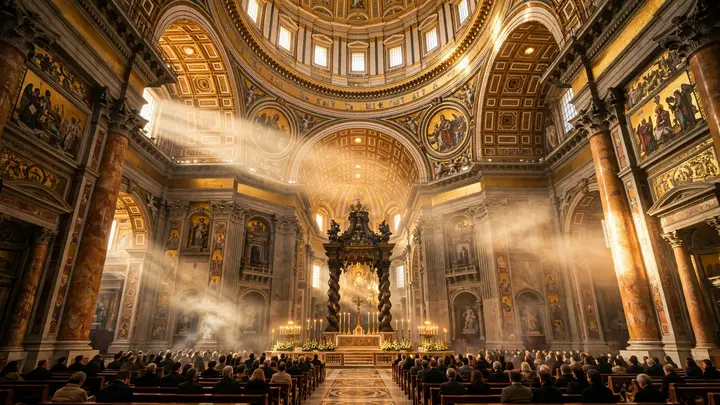
Pope Leo XIV celebrated Mass in St Peter's Basilica on Wednesday 18 November 2026, marking exactly 400 years since the dedication of the current basilica on 18 November 1626. The Chicago-born pontiff led the liturgy beneath the soaring dome, holding up the Book of the Gospels before the faithful gathered in the Vatican.
One hundred and twenty years — that is how long the basilica took to build. Twenty pontificates came and went while the stones were being laid, and twelve architects put their hands to the work before it was finished. Four centuries later, the building they left behind still stands at the heart of Roman Catholicism, and the Mass on Wednesday was its birthday.
St Peter's Basilica is built on the tomb of St Peter, and it has been called "the parish church of the world." Pilgrims arrive from every continent, and many of them have waited years for the moment they step through its doors. On Wednesday, they came for a different reason: to mark the day the building itself was given to God.
120 Years, 20 Pontificates, 12 Architects: How St Peter's Basilica Was Built
The basilica did not rise in a quiet age. It survived the Protestant Reformation, which began in 1517, and the Sack of Rome in 1527, when the city itself was torn apart. The builders kept going through it all, generation after generation, even when the world around them seemed to be falling apart.
Print it, pray through it, and share it with your family or small group.
That is the begining of the story Leo wanted the faithful to remember. A church that took 120 years to finish was never a project of one man, one pope, or one lifetime. It was the work of people who laid stones they knew they would never see crowned, trusting that someone else would finish what they had started.
Pope Urban VIII dedicated the finished basilica on 18 November 1626, exactly four hundred years before Wednesday's Mass. During that dedication, Urban VIII anointed blue and red mosaic crosses on the nave walls with oil. Those same crosses were still there on Wednesday, and they were closer than anyone expected.
The Crosses on the Mitre: A 1626 Detail Returns to St Peter's
Pope Leo wore a mitre bearing the blue and red mosaic crosses from the 1626 dedication, according to the National Catholic Register. The crosses Urban VIII anointed with oil four centuries ago were represented on the head of the pope celebrating the anniversary. It was a small detail, and it carried the whole day inside it.
The date itself matched the original basilica's consecration, and the liturgy was shaped around that echo. Four hundred years is a long time for any building to keep its meaning, yet the crosses on the walls and the crosses on the mitre said the same thing: this place was set apart once, and it is set apart still.
Leo held up the Book of the Gospels beneath the dome, in a photograph that quickly travelled around the world. The image showed the pontiff small beneath the vastness of the basilica, and the contrast was the point. The building dwarfs everyone who stands inside it, and it has done so for four centuries.
Pope Leo XIV Homily: Christ Is the Cornerstone of the Church
In his homily, Leo said Christ is the one cornerstone of the Church's mission. He told the faithful that the basilica invites belief "not because the beautiful stones that comprise the building, but because of the faith that shines through them." The stones are beautiful, he said, but the faith is what makes them shine.
He spoke of the feeling the building stirs in everyone who enters it.
"Visiting this majestic church always stirs emotion: We are filled with awe, inspired by the sacredness of faith, the power of history and the beauty of art."
It was a line that reached beyond the congregation in the pews. Anyone who has walked into St Peter's for the first time knows the feeling Leo was describing: the sudden silence, the neck craned upward, the sense that the room is bigger than the person standing in it. The pope was naming something millions of visitors have felt and struggled to put into words.
Leo also spoke of the builders themselves, describing the basilica as the work of "the greatest minds of the age," according to the National Catholic Register. Those minds are long gone, yet their work still gathers people every single day. The homily kept returning to the same idea: what endures is not the marble, but the faith that built it.
A Church Built to Welcome: What 400 Years Still Means Today
"The vastness of the Vatican Basilica reflects an enduring vocation to welcome, so that as many people as possible may find a place in the church," Leo said. The building is vast on purpose, he suggested, because welcome is its job. There must always be room for one more person.
🙏 Did this part inspire you?
That idea has shaped Leo's first months as pontiff. Pope Leo XIV Says Holiness Is for Everyone at All Saints Angelus November 1 2026 carried the same open-door message, and Pope Leo XIV Angelus Today October 25 2026: Love God Must Overflow Into Love for Neighbours pressed the faithful to let love spill outward.
The welcome keeps turning into action. Pope Leo XIV Yemen Appeal Today: Pontiff Pleads for Taiz After Surgery October 2026 showed it becoming a plea for a suffering people, while Chris Pratt Vatican Documentary: Actor Calls St. Peter's Tomb Experience 'Really Profound' showed how the basilica still moves visitors who come for the first time.
The basilica has outlasted empires, reformations, sackings, and centuries of change. It has watched popes come and go, and it has buried some of them beneath its floor. Through it all, the doors have stayed open, and the faithful have kept arriving.
Four hundred years from now, will another pope stand beneath the same dome and mark another anniversary? The building was raised by people who would never see it finished, and it still stands because each generation refused to let it fall. The crosses on the wall have not faded, the dome has not fallen, and the invitation Leo spoke of on Wednesday is still open — and the question the anniversary leaves behind belongs to everyone who heard it: if a church built over 120 years could outlast every storm thrown at it, what could a faith built the same way, slowly, patiently, stone upon stone, still do?
Frequently asked questions
Pope Leo XIV celebrated the Mass on Wednesday 18 November 2026, exactly 400 years after Pope Urban VIII dedicated the current basilica on 18 November 1626.
The basilica took 120 years to build, spanning 20 pontificates and 12 architects. It survived the Protestant Reformation, which began in 1517, and the Sack of Rome in 1527 before its dedication in 1626.
According to the National Catholic Register, the blue and red mosaic crosses on the nave walls were anointed with oil by Pope Urban VIII during the 1626 dedication. Those same crosses were represented on Pope Leo XIV's mitre at the anniversary Mass.
Leo said Christ is the one cornerstone of the Church's mission, and that the basilica invites belief "not because the beautiful stones that comprise the building, but because of the faith that shines through them." He added that the basilica's vastness reflects "an enduring vocation to welcome, so that as many people as possible may find a place in the church."
St Peter's Basilica stands in Vatican City, built on the tomb of St Peter. It is called "the parish church of the world" because pilgrims from every continent come to worship there, and it stands at the heart of Roman Catholicism.
🙏 Did this part inspire you?
Print it, pray through it, and share it with your family or small group.
🔔 Don't Miss the Next Story!
Get breaking Christian news on your phone before everyone else — allow notifications when prompted, or join our newsletter below!
But the most surprising part of this story is yet to come — keep reading.
🙏 Have a Testimony to Share?
Has God done something amazing in your life? Or want us to cover a specific story? Send your testimony or story request via WhatsApp — your story could encourage thousands!
💬 Comments
Share your thoughts below. Be kind and respectful. If this story touched you, let us know in the comments!