🎧 Listen to This Story (Audio Mode)
Saved for offline reading — text only; photos need the internet.
US Bishops Meet in Baltimore November 16-19 to Tackle AI, Immigration and Church Renewal
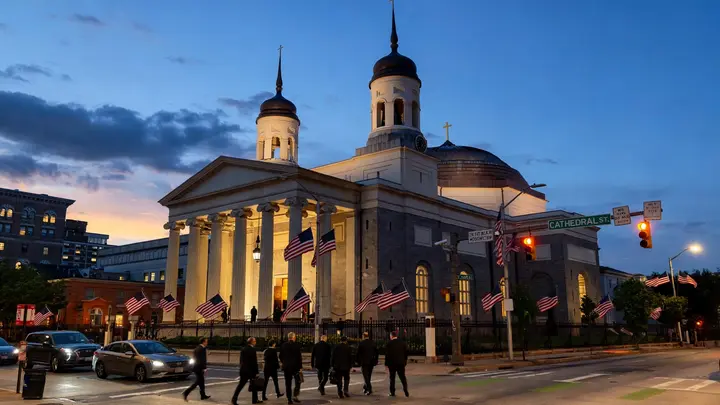
The U.S. Conference of Catholic Bishops (USCCB) will gather in Baltimore, Maryland, from November 16 to 19 for its 2026 Fall Plenary Assembly, with public sessions on November 17 and 18 livestreamed on the USCCB website. The agenda puts three big questions in front of the bishops at once: artificial intelligence, immigration, and signs of renewal in the Church. They will also vote on liturgical texts, canonization causes and leadership.
Consider the man carrying the AI question into the room. Bishop Oscar Cantú of San Jose, California, leads the bishops' new task force on artificial intelligence, and his diocese sits in the heart of Silicon Valley, where the machines are built. The bishop from the home of AI must now help the Church decide what AI means for human dignity.
AI After Magnifica Humanitas: Bishop Oscar Cantú and the Task Force
The bishops will hear an update from the new Task Force on Preserving Human Dignity in the Age of Artificial Intelligence, chaired by Bishop Cantú. The task force was formed in response to Pope Leo XIV's encyclical Magnifica Humanitas, and it brings together eight bishops, including Cardinal Blase Cupich, with three lay consultants: theologian Charles Camosy, philosopher Meghan Sullivan of Notre Dame, and Kim Daniels of Georgetown University.
Print it, pray through it, and share it with your family or small group.
The group's focus is human dignity and the common good in AI development, a message explored by the Pope. AI already shapes work, education and the formation of the young, and the Church is being asked to say clearly where the line falls between a tool and a person, as Pope Leo himself put it when he said machines are tools, not persons, as reported in Pope Leo XIV: Machines Are Tools, Not Persons in Vatican AI Address.
Immigration One Year After the Special Message
One year after the bishops adopted their special message on immigration, the Committee on Migration will brief the assembly, with Bishop Brendan Cahill of Victoria, Texas, giving the update. The original message opposed the indiscriminate mass deportation of people, and it was the conference's first special message in 12 years, as reported in US Catholic Bishops Oppose Indiscriminate Mass Deportation in First Special Message in 12 Years.
A year is long enough to measure what a statement changed. For the parishes along the border, migration is not a file on an agenda. It is the people in the pews.
Church Renewal: Conversions, Young Adults and the Guadalupan Novena
The bishops are also expected to discuss evidence of increased conversions and a resurgence of religious interest among young adults, in a panel on new life in the Church. After years of grim numbers, the panel will ask whether something is genuinely turning, and what the Church should do to recieve the seekers who are arriving.
Bishop Robert Brennan of Brooklyn, who chairs the Committee on Cultural Diversity in the Church, will update the bishops on the Intercontinental Guadalupan Novena. The novena ties the renewal conversation to Our Lady of Guadalupe, a devotion that reaches across the Americas.
Votes in Baltimore: Lectionary, Sainthood Causes and a New Secretary
The bishops will vote on a new edition of the Lectionary for Mass and the Book of the Gospels, and on an annual Day of Prayer for Racial Justice. They will vote on the USCCB budget for 2027, on an update of the pro-life pastoral plan, and on updates to the conference's financial reporting and investment guidelines.
They will also vote on whether to support investigating the canonization causes of Maria Middleton and Thomas Steven Vander Woude, two Americans whose causes are being investigated by their dioceses. And with terms expiring, they will elect a new secretary, choosing between Bishop Kevin Rhoades of Fort Wayne-South Bend and Bishop Earl Fernandes of Columbus. They will also elect chairmen of six committees, including Catholic Education, Communications, Cultural Diversity, Doctrine, National Collections and Pro-Life Activities, each serving as chairman-elect for one year before a three-year term from the fall of 2027.
The public portion will open with an address by Archbishop Paul Coakley of Oklahoma City, the USCCB president, and the bishops will also hear from Archbishop Gabriele Caccia, the papal nuncio to the United States. The gathering has been livestreamed for 15 years, and the public sessions on November 17 and 18 will stream at usccb.org/meetings.
What the bishops decide in Baltimore will not stay in Baltimore. An AI framework shaped by the Church, a migration stance tested a year after it was written, and a renewal story that may or may not be real: each will reach parishes across the country in the weeks that follow. The votes will show whether this meeting talked about the future, or started building it.
🙏 Did this part inspire you?
Frequently asked questions
The agenda is expected to include an AI task force update from Bishop Oscar Cantú, a migration update one year after the bishops' special message opposing indiscriminate mass deportation, an update on the Guadalupan Novena, and a panel on new life in the Church.
Bishop Oscar Cantú of San Jose chairs the Task Force on Preserving Human Dignity in the Age of Artificial Intelligence. It includes eight bishops, among them Cardinal Blase Cupich, and three lay consultants: Charles Camosy, Meghan Sullivan and Kim Daniels. It was formed in response to Pope Leo XIV's encyclical Magnifica Humanitas.
The bishops will vote on a new edition of the Lectionary for Mass and Book of the Gospels, an annual Day of Prayer for Racial Justice, the 2027 budget, an update of the pro-life pastoral plan, financial guidelines, and whether to support investigating the canonization causes of Maria Middleton and Thomas Steven Vander Woude.
The bishops will elect a new secretary, choosing between Bishop Kevin Rhoades of Fort Wayne-South Bend and Bishop Earl Fernandes of Columbus. They will also elect chairmen of six USCCB committees.
Print it, pray through it, and share it with your family or small group.
🔔 Don't Miss the Next Story!
Get breaking Christian news on your phone before everyone else — allow notifications when prompted, or join our newsletter below!
But the most surprising part of this story is yet to come — keep reading.
🙏 Have a Testimony to Share?
Has God done something amazing in your life? Or want us to cover a specific story? Send your testimony or story request via WhatsApp — your story could encourage thousands!
💬 Comments
Share your thoughts below. Be kind and respectful. If this story touched you, let us know in the comments!