🎧 Listen to This Story (Audio Mode)
Saved for offline reading — text only; photos need the internet.
Texas Asks Supreme Court to Skip Ten Commandments Case as Incoming Attorney General Nathan Johnson Refuses to Defend SB 10
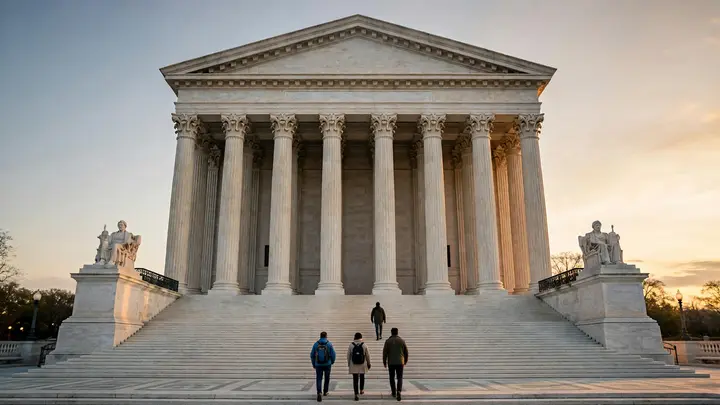
Texas has asked the US Supreme Court not to hear the challenge to its law requiring the Ten Commandments in every public school classroom. In a brief filed on 10 November 2026, outgoing Attorney General Ken Paxton's office argued the case is a poor vehicle — because the man about to take over the office, Democrat Nathan Johnson, has publicly said he will not defend the law.
It is a strange position for a state that won in the court below to take. Texas beat the challengers in the Fifth Circuit in April, yet it is now telling the justices to walk away, at least partly because its own incoming attorney general has already walked away from the law.
The law at the centre of it all is Senate Bill 10. It requires every public school classroom in Texas to display a 16-by-20-inch poster of the Ten Commandments, drawn from the King James Bible. Schools that do not buy their own must put up donated ones, though teachers need not teach the text.
The case is Nathan v. Alamo Heights ISD, No. 26-257, brought by nonreligious and multifaith families who sued in July 2025. A federal judge blocked the law, but the Fifth Circuit revived it in April 2026, ruling 9–8 that the 1980 precedent Stone v. Graham was effectively dead after the Supreme Court's 2022 decision in Kennedy v. Bremerton. The families asked the Supreme Court to step in during August.
Print it, pray through it, and share it with your family or small group.
Ken Paxton Brief: Ten Commandments SB 10 Is a Poor Vehicle for Review
Paxton's brief gives the justices three reasons to say no. First, there is no error to correct, because Stone v. Graham "fell with Lemon" — the test the Supreme Court abandoned in Kennedy. Second, lower appeals courts should weigh in further before the justices decide.
Third, the case is a poor vehicle, because the claims are facial and mostly pre-enforcement challenges rather than attacks on a specific display.
"Among other factors, the recent election in Texas renders this case a particularly poor vehicle."
That is the brief's polite way of naming the problem in the attorney general's office. Johnson, a Democratic state senator, beat Republican Mayes Middleton on 3 November and takes office in January 2027. Paxton, meanwhile, ran for the US Senate instead — and lost to James Talarico, as reported in James Talarico Wins Texas Senate Seat as First Democrat Since 1988.
Nathan Johnson Will Not Defend Ten Commandments Law
Johnson's position is on the record. In an interview during the Democratic primary in April, he told CBS News Texas: "I will not defend the legislature's passage of a requirement that schools place the Ten Commandments in classrooms because it's unconstitutional."
Asked whether the state would then need private lawyers, he said yes: "That might be a good conversation for me to have with the legislature before they pass the next ill-advised and unconstitutional law."
The brief never names Johnson. It does not need to. It says only that "[t]he newly elected attorney general of Texas (Nathan Johnson), set to assume office in January 2027, has publicly stated that he will not defend the law at issue." The Atheist Post found no statement from Johnson on the case since the election, so the April interview remains the only evidence of his position — and Paxton's office is treating it as enough.
Graham still lives, and whether a state can post scripture where children cannot look away, is still waiting for its answer.
"If the court were to grant review, the new attorney general appears to be unwilling to defend Texas law, leaving this court to decide significant Establishment Clause and Free Exercise Clause issues without the benefit of 'an adversary presentation' from those responsible for the state's enforcement of the law," the brief states.
Stone v. Graham and Ten Commandments Classrooms: What the Fifth Circuit Decided
The Fifth Circuit's April ruling is why this case matters far beyond Texas. The court took the appeal en banc from the outset, alongside Louisiana's case, and on 21 April vacated the injunction and dismissed the claims. The 9–8 vote occured in an unusual split: three judges in the majority found the plaintiffs lacked standing at all.
The majority held that Stone rested on the Lemon test, which the Supreme Court abandoned in Kennedy v. Bremerton in 2022. The dissenters said Stone still binds lower courts until the justices themselves say otherwise. In plain terms, a 9–8 appeals court has declared a Supreme Court precedent dead without the Supreme Court saying so.
The families argue the law is coercive, imposing religious messages on a captive audience of students for nearly every hour they are in school. Their petition says SB 10 "contravenes these basic First Amendment tenets" and interferes with parents' rights to direct their children's religious education, a point the Supreme Court affirmed in Mahmoud v. Taylor in 2025.
Paxton's brief answers that the law was meant to "restore the history and tradition of the Ten Commandments in our state and our nation" and to "remind students all across Texas of the importance of a fundamental foundation of American and Texas law." History and tradition, not religion, is the argument the state goverment used to win below — and the one it now seems reluctant to make again.
🙏 Did this part inspire you?
Texas is not alone. Arkansas' Ten Commandments law is before the Eighth Circuit, Tennessee's governor signed one in July, and Alabama schools are set to install displays by 1 January, as reported in Alabama Votes 63% for School Prayer in Constitution.
What Happens Next for the Texas Ten Commandments Case
What happens next is simple to describe and impossible to predict. The families can now file a reply. Granting review takes four votes, and the Court has no deadline.
A Louisiana teacher's petition, Dier (No. 26-256), is also pending, and Louisiana opposes it — while Texas has asked the Court, if it takes the case anyway, to also grant Louisiana's conditional petition, Brumley v. Roake (No. 25-1360).
The Court's appetite for religion cases is no secret: it is leaning toward Catholic schools in Colorado, as reported in Supreme Court Leans to Catholic Schools in Colorado Case, and preparing to decide whether Colorado can block Catholic preschools, as reported in Latest: St. Mary v. Roy — Supreme Court to Decide if Colorado Can Block Catholic Preschools (2026).
So the Ten Commandments may stay on Texas classroom walls not because the Supreme Court blessed them, but because the man hired to defend them refused — and the justices decided the fight was not worth having yet. The question of whether Stone v. Graham still lives, and whether a state can post scripture where children cannot look away, is still waiting for its answer. And the next time it arrives at the Court's door, the attorney general answering may be a very different one.
Frequently asked questions
Senate Bill 10 is a Texas law requiring every public school classroom to display a 16-by-20-inch poster of the Ten Commandments, drawn from the King James Bible. Schools that do not buy their own displays must put up donated ones, though teachers are not required to teach the text.
In a brief filed 10 November 2026, outgoing Attorney General Ken Paxton's office gave three reasons: there is no error to correct because Stone v. Graham "fell with Lemon"; lower courts should weigh in further; and the case is a poor vehicle because the claims are facial and mostly pre-enforcement — and because incoming Attorney General Nathan Johnson has said he will not defend the law, leaving the Court without an adversary presentation.
Nathan Johnson is a Democratic state senator who beat Republican Mayes Middleton on 3 November 2026 and takes office as Texas attorney general in January 2027. In an April 2026 interview with CBS News Texas, he said: "I will not defend the legislature's passage of a requirement that schools place the Ten Commandments in classrooms because it's unconstitutional."
On 21 April 2026, the Fifth Circuit ruled 9–8 en banc to vacate the injunction against SB 10 and dismiss the families' claims. The majority held that Stone v. Graham rested on the Lemon test, which the Supreme Court abandoned in Kennedy v. Bremerton (2022). The dissenters said Stone still binds lower courts until the justices say otherwise.
That is undecided. Granting review takes four votes, and the Court has no deadline to decide, though the challenging families can file a reply and a Louisiana teacher's petition (Dier, No. 26-256) is also pending. The Court sometimes appoints an outside lawyer to defend a position a party has dropped, which weakens Texas's no-adversary argument.
🙏 Did this part inspire you?
Print it, pray through it, and share it with your family or small group.
🔔 Don't Miss the Next Story!
Get breaking Christian news on your phone before everyone else — allow notifications when prompted, or join our newsletter below!
But the most surprising part of this story is yet to come — keep reading.
🙏 Have a Testimony to Share?
Has God done something amazing in your life? Or want us to cover a specific story? Send your testimony or story request via WhatsApp — your story could encourage thousands!
💬 Comments
Share your thoughts below. Be kind and respectful. If this story touched you, let us know in the comments!