Christian Relief Groups Rush to Florida and Alabama After Hurricane Isaias
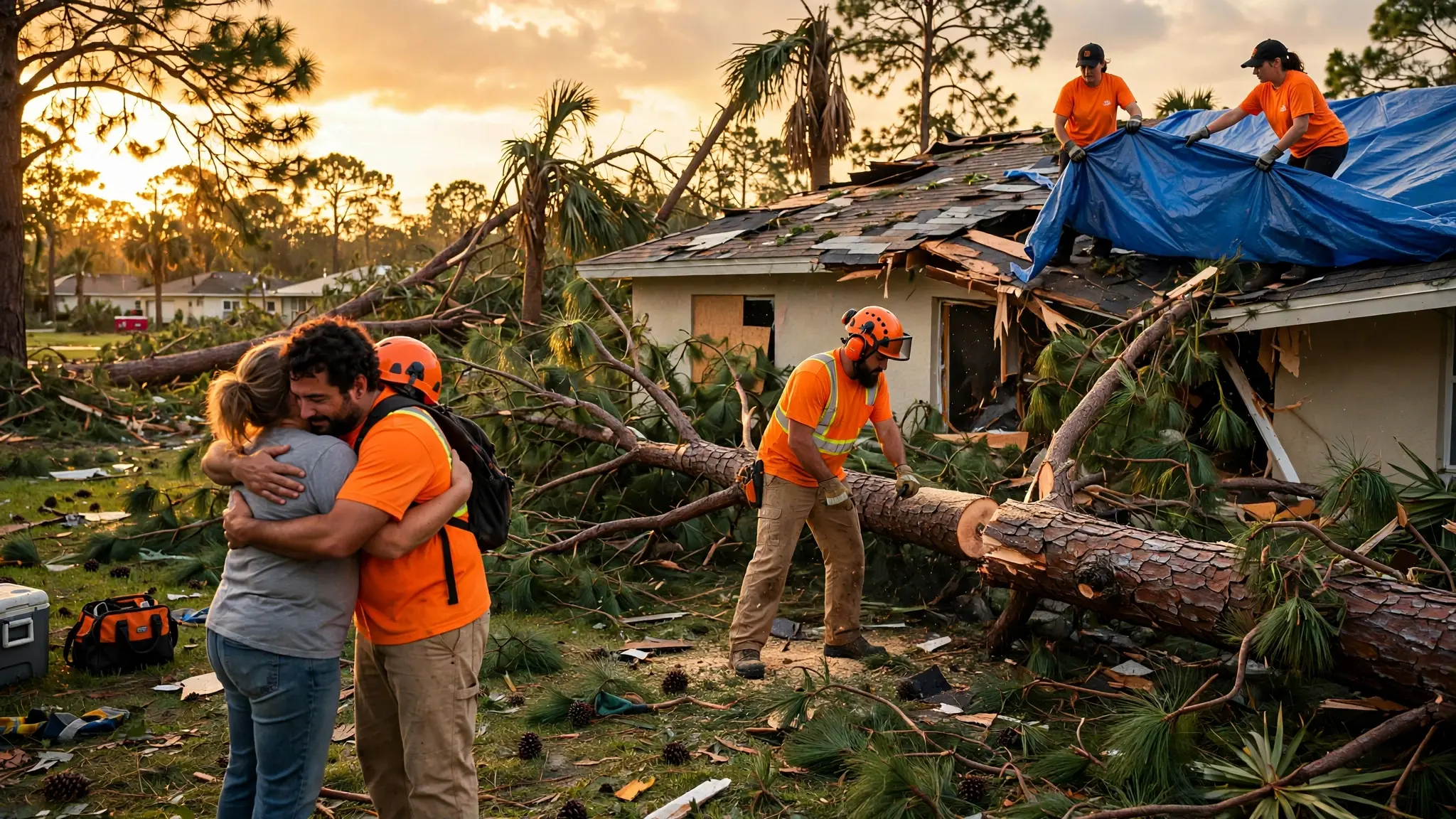
By Tuesday morning, a small church parking lot in Pace, Florida, had turned into a disaster-relief command post. Nearly 800 homeowners had asked for help in just a few days. Samaritan's Purse — the ministry founded by Franklin Graham — had barely unpacked its tools, and already the phones would not stop ringing.
Hurricane Isaias came ashore near Destin on the night of Friday, October 9, 2026, as a Category 2 storm with sustained winds near 105 miles per hour. At least four people died, and hundreds of thousands of families lost power across the Florida Panhandle and southern Alabama. Roads were blocked by fallen pines and roofs peeled open to the sky — yet by the following weekend, orange shirts were already on the scene.
The ministry deployed two of its Disaster Relief Units — tractor trailers packed with chainsaws, tools, and equipment — and set up base at Immanuel Baptist Church in Pace, Florida, and First Baptist Church in Brewton, Alabama. Volunteers began work on October 12, cutting felled trees, hauling debris, and stretching blue tarps over broken roofs. The ask was simple, the ministry said: come serve people in the name of Jesus.
Samaritan's Purse Disaster Relief: Two Units, Nearly 800 Work Orders
Joni Byker, the ministry's North American Disaster Relief director, described the mission in words that have become the heartbeat of the response. Teams were not coming just with chainsaws, she said — they were coming with something harder to deliver.
We want to come with the hope of the Gospel, let them know that they're seen, let them know that God sees them and He has not forgotten them and that we're here to help them. — Joni Byker, director of North American Disaster Relief, Samaritan's Purse (Christian Post)
That line has echoed through the relief effort: for familes sitting in dark houses beside blue-tarped roofs, the message was that they were not invisible. Volunteers prayed with homeowners at front doors, then climbed onto their roofs. It is a pattern Faith Stories has followed before, in stories of churches stepping up where the need is greatest, from revival nights to disaster zones.
Working alongside the orange-shirted crews, the Billy Graham Evangelistic Association Rapid Response Team deployed crisis-trained chaplains. While volunteers cleared branches and dragged tarps, chaplains sat with storm-shaken residents, listened, and shared the hope of the Gospel. The partnership is a familiar one: Samaritan's Purse clears the yard, and the chaplains tend to the heart.
Churches Feeding Thousands: 1,800 Hot Meals and Counting
Before the chainsaws arrived, the kitchens did. Eight Days of Hope sent in its mass feeding arm first, partnering with Destiny Worship Center in Navarre to deliver 1,800 hot meals to families with no power and no way to cook. Steve Tybor, the ministry's president, put the commitment in plain words.
We're going to feed people until the power comes back on. — Steve Tybor, president of Eight Days of Hope (American Family News)
No conditions, no sign-ups, no paperwork. Just food, served fast, to neighbors who had lost their refrigerators and their routines in a single night. The ministry's promise — to keep feeding people as long as the lights stay out — turned a church fellowship hall into the busiest restaurant on the Panhandle.
Southern Baptist Disaster Relief was right there too, serving 2,000 meals in Pensacola, while Convoy of Hope and Church of the Highlands teams mobilized across the region. Different logos, different trucks, same mission: hot food, clean water, and a reminder that the Church shows up when the sky falls.
That instinct — to run toward the wreckage instead of away from it — is the same one driving the 550 Christians baptized in the freezing North Sea and the steady rise in UK church attendance now in its fifth straight year. The church that kneels in worship is the same church that climbs onto storm-damaged roofs.
A Storm That Tested Faith — and a Response That Answered
Four lives lost, hundreds of thousands in the dark, eight hundred work orders and counting. The numbers tell one story. The orange shirts tell another: within 72 hours of landfall, churches across two states were cooking, cutting, tarping, and praying.
The recovery will take months. Insurance adjusters will argue and contractors will be booked solid. But the volunteers in Pace and Brewton did what they always do: they showed up early, stayed late, and treated each work order as more than a job ticket — each one a family, each one seen.
And for the churches that opened their parking lots and fellowship halls, the storm became an unlikely sanctuary. As the prayers that carried Pope Leo XIV through his recovery showed earlier this month, faith does not sit still in a crisis. It feeds people, cuts trees, and tarps roofs — and it keeps coming back, day after day, until the power comes back on.
The lights will eventually return to the Panhandle. The tarps will come down, one roof at a time. But the question hanging over every work order — the one the chaplains keep hearing at the front doors of Pace and Brewton — is the one that matters most: when the trucks pull out and the cameras move on, will anyone still be there to help with the long, slow work of rebuilding?
Frequently Asked Questions
Hurricane Isaias made landfall near Destin, Florida, on the night of October 9, 2026, as a Category 2 storm with sustained winds near 105 miles per hour, killing at least four people and knocking out power to hundreds of thousands.
The ministry deployed two Disaster Relief Units to Immanuel Baptist Church in Pace, Florida, and First Baptist Church in Brewton, Alabama. By Tuesday morning it had received nearly 800 work orders for cutting fallen trees, clearing debris, and tarping damaged roofs.
Eight Days of Hope delivered 1,800 hot meals through Destiny Worship Center in Navarre, while Southern Baptist Disaster Relief served 2,000 meals in Pensacola.
Yes. The Billy Graham Evangelistic Association Rapid Response Team deployed crisis-trained chaplains to work alongside Samaritan's Purse crews, sharing the hope of the Gospel with storm-affected families.
Samaritan's Purse asked for more volunteers to serve in Florida and Alabama through its website, and ministries like Eight Days of Hope accept donations and volunteers for ongoing disaster work.
🔔 Don't Miss the Next Story!
Get breaking Christian news on your phone before everyone else — allow notifications when prompted, or join our newsletter below!
But the most surprising part of this story is yet to come — keep reading.
🙏 Have a Testimony to Share?
Has God done something amazing in your life? Or want us to cover a specific story? Send your testimony or story request via WhatsApp — your story could encourage thousands!
💬 Comments
Share your thoughts below. Be kind and respectful. If this story touched you, let us know in the comments!