🎧 Listen to This Story (Audio Mode)
Saved for offline reading — text only; photos need the internet.
Nigeria Catholic Bishops Warn Christian Persecution Is Getting Worse Today
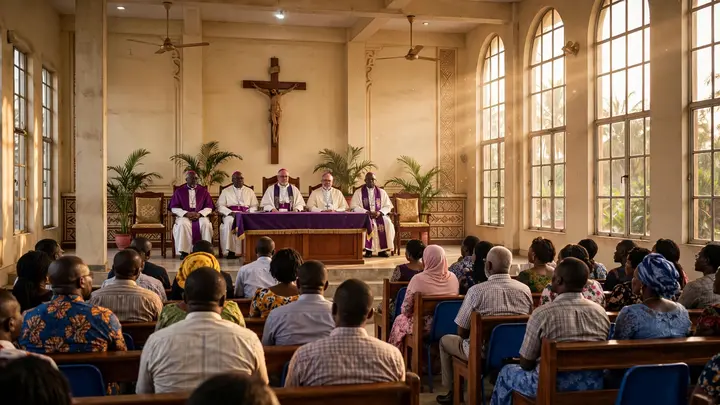
Catholic bishops in Nigeria warned this weekend that violent persecution of Christians has grown worse over the last twenty years, with the Vatican's envoy joining them in Owerri to say the time for politics and pretence is over. The warning came at the 18th National Conference of the Association of Papal Knights and Medalists in Nigeria (APKMN) in Owerri, Imo State, held under the theme "Strategic Engagements in Addressing Christian Persecution in Nigeria: Toward Coordinated Response". Vanguard reported the bishops' alarm on Sunday 15 November, only hours after the conference, while the Daily Post carried the first accounts late on Saturday night.
Seven out of every ten Christians killed for their faith anywhere in the world last year were Nigerians. That is the number behind the bishops' warning.
Open Doors' World Watch List 2026 records that 3,490 of the 4,849 Christians killed worldwide for their faith — 72 per cent — were Nigerians. It is a figure that turns an abstract debate about persecution into a count of graves, and it is why the bishops in Owerri spoke in the bluntest terms they have used in years.
Archbishop Crotty: Violent Persecution More Pronounced in Nigeria
Archbishop Michael Francis Crotty, the Apostolic Nuncio to Nigeria and the Vatican's envoy in the country, told the conference that Christians had suffered persecution in different forms throughout Nigeria's history. But the violent forms of persecution, he said, had become more pronounced in the last two decades.
Print it, pray through it, and share it with your family or small group.
"The time for politics and pretence over Christian persecution was over," Bishop Wilfred Chikpa Anagbe of Makurdi said, in words echoed by the conference's National Chaplain, Rev. Fr. Michael Adegbola. The two men were speaking for a room full of Catholic knights and medalists — lay men and women honoured by the Pope for service to the Church — who had gathered to ask what a coordinated response to the violence should look like.
Crotty urged Christians to respond through democratic engagement ahead of elections, and said ending the persecution was imperative. His message was practical rather than only pastoral: faith, he argued, has to show up at the ballot box as well as in the pew, because the protection of Christians in Nigeria will ultimately be decided by the country's laws and its leaders.
Archbishop Ugorji: Christian Genocide Debate in Nigeria
Archbishop Lucius Iwejuru Ugorji of Owerri, who hosted the conference in his archdiocese, said the persecution of Christians — described by some as "Christian genocide" — is one of the most discussed issues in Nigeria today. He said it is rooted in a volatile mix of religious, ethnic and economic factors, a tangle that makes simple explanations dishonest and simple solutions impossible.
Ugorji recalled the United States' designation of Nigeria as a Country of Particular Concern (CPC) under the International Religious Freedom Act of 1998, a step taken in October 2025 over recurring attacks on Christians. The designation put Nigeria on a short list of countries the US government says engage in or tolerate severe violations of religious freedom, and it has kept the country's crisis in front of Washington ever since.
The archbishop's point was not about American politics. It was that the world is watching, and that the Church in Nigeria can no longer be expected to absorb the violence quietly. The same concern has driven Nigerians to speak up in ever larger numbers, as shown when hundreds of thousands signed a petition for the protection of persecuted Christians, as reported in Arise Africa Petition Today: 919,600 Signatures to Protect Persecuted Christians.
Nigeria Bishops: Time for Politics and Pretence Is Over
The bishops' language at Owerri was striking because it was aimed as much at Christians as at their attackers. Anagbe and Adegbola were saying, in effect, that polite silence has failed.
For years, church leaders have issued statements after each attack, buried the dead, and waited for the next one. The conference's theme — strategic engagement toward a coordinated response — was an admission that statements alone are not enough.
That coordinated response, as Crotty framed it, starts with democratic engagement. Christians in Nigeria are numerous, organised and spread across every region, yet their voice in public life has often been muted by division and fear. The Nuncio's call ahead of elections was a call to turn that size into influence: to vote, to organise, to demand that candidates answer for the safety of Christian communities.
The warning lands in a year when the violence has barely paused. In Adamawa State, whole Christian villages have been emptied by attacks this year, as reported in Boko Haram Destroys Church in Adamawa as Eight Christian Villages Displaced in Nigeria.
In Plateau State, gunmen killed three miners at a mining site, as reported in Gunmen Kill 3 Miners at Plateau Mining Site in Nigeria. And kidnapped Christian girls have died days after their release, as reported in Kidnapped Christian Girls Die Days After Release in Nigeria.
Nigeria Christians Killed: 3,490 of 4,849 Worldwide
The Open Doors figure — 3,490 Nigerian Christians killed out of 4,849 worldwide — is the statistic the bishops keep returning to, because it answers the question of whether Nigeria's crisis is real or exaggerated. It is not a claim made by one church or one party. It is a count compiled by researchers who track killings of Christians country by country, and Nigeria dominates it.
🙏 Did this part inspire you?
A US House hearing earlier this year reached the same conclusion from a different direction, finding that Nigeria accounts for 72 per cent of Christian killings worldwide, as reported in Latest: US House Hearing Finds Nigeria Accounts for 72% of Christian Killings Worldwide. The hearing described the US goverment's own response as inadequate, a verdict that still hangs over Washington's policy toward Abuja.
Behind the numbers are churches that no longer meet on Sundays, villages that no longer exist, and families seperated from their homes who have fled to camps where the food runs short and the future is uncertain. The bishops in Owerri were speaking for those families as much as for themselves, and their warning was that the count will keep rising unless something changes.
What Happens Next for Christians in Nigeria?
The conference has ended, but the question it raised has not. The bishops have called for a coordinated response and for democratic engagement ahead of elections, yet the violence they described has outlasted many such calls before.
What happens in the months ahead — whether Christians organise as Crotty urged, whether the government acts, and whether the world keeps watching — will show if this weekend in Owerri was a turning point, or another warning that was heard and then forgotten. The next attack, and the response to it, will tell.
Frequently asked questions
At the 18th National Conference of the Association of Papal Knights and Medalists in Owerri, the bishops warned that violent persecution of Christians in Nigeria has grown worse over the last twenty years, and said the time for politics and pretence over the issue is over.
Archbishop Michael Francis Crotty is the Apostolic Nuncio to Nigeria, the Vatican's envoy in the country. At the Owerri conference he said Christians had suffered persecution in different forms throughout Nigeria's history, but that violent forms had become more pronounced in the last two decades.
Open Doors' World Watch List 2026 records that 3,490 of the 4,849 Christians killed worldwide for their faith — 72 per cent — were Nigerians.
The United States designated Nigeria a Country of Particular Concern under the International Religious Freedom Act of 1998 in October 2025, over recurring attacks on Christians. It places Nigeria among the countries the US says engage in or tolerate severe violations of religious freedom.
Archbishop Crotty urged Christians to respond through democratic engagement ahead of elections, and said ending the persecution was imperative. Bishop Anagbe and Fr. Adegbola said the time for politics and pretence was over.
🙏 Did this part inspire you?
Print it, pray through it, and share it with your family or small group.
🔔 Don't Miss the Next Story!
Get breaking Christian news on your phone before everyone else — allow notifications when prompted, or join our newsletter below!
But the most surprising part of this story is yet to come — keep reading.
🙏 Have a Testimony to Share?
Has God done something amazing in your life? Or want us to cover a specific story? Send your testimony or story request via WhatsApp — your story could encourage thousands!
💬 Comments
Share your thoughts below. Be kind and respectful. If this story touched you, let us know in the comments!