🎧 Listen to This Story (Audio Mode)
Saved for offline reading — text only; photos need the internet.
Salzburg Blocks Red Week Lights for Persecuted Christians
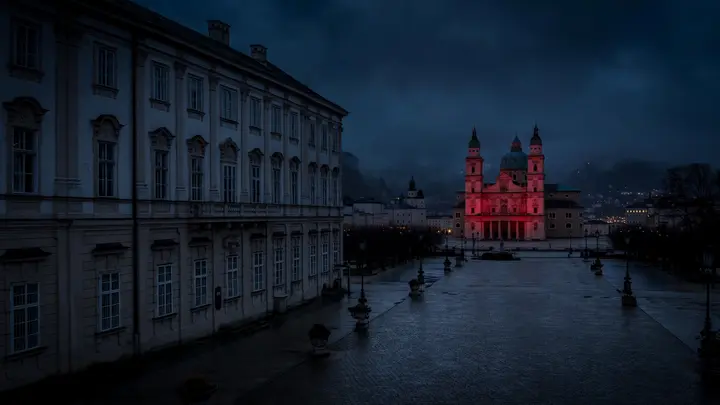
Salzburg's deputy mayor Kay-Michael Dankl, a 38-year-old member of Austria's Communist Party, blocked the city government from lighting its historic Mirabell Palace red for Red Week, the worldwide commemoration of persecuted Christians. The Christian Post reported the decision on 19 November 2026.
The palace stayed dark this year. Last year, it glowed red like hundreds of other buildings around the world. And in February, the same palace opened its Marble Hall to about 1,000 people for a large Iftar festival marking Ramadan. One faith's festival was welcomed inside. The other's memorial was refused outside. That contrast is what turned a lighting decision into a story.
Dankl instructed his city against lighting Mirabell Palace, the headquarters of the city government, in red to mark Red Week, according to Austrian outlet Salzburg24. Thousands of churches, monuments and public buildings — including at least 130 cathedrals — are being flooded with blood-red light this week as part of the annual initiative organized by Aid to the Church in Need (ACN), a Roman Catholic pontifical charity and persecution watchdog. The light stands for the hundreds of millions of Christians worldwide who face persecution for their faith.
Why Salzburg's Mirabell Palace Stayed Dark This Red Week
Dankl took issue with what he called the explicitly Christian nature of the event. "We do not want to set an example for just a single religion," he told Salzburg24. He argued instead that lighting the palace with white on 22 August, to mark the United Nations' day commemorating persecution against all religious beliefs, is more appropriate.
Print it, pray through it, and share it with your family or small group.
He also announced that orange lighting will illuminate the palace for 16 days starting 25 November, as a sign against violence toward women. The palace, it seems, can be lit for causes. It can be lit in white, and in orange, and it can host an Iftar feast for a thousand guests. What it could not be lit for, this year, was persecuted Christians in red.
Mirabell Palace was built in 1606 at the behest of the Roman Catholic prince-archbishop of Salzburg at the time. It is, in stone and in history, a Christian building in a historically Christian city — a city that held its first "Islam Week" in February, when the city government's diversity team worked with Salzburg's growing Islamic community to mark Ramadan with the Iftar festival in the Marble Hall. The hall had also hosted an Iftar celebration in 2025. Nobody objected to that. The objection, this week, ran the other way. Notre-Dame and Sacré-Cœur Glow Red on Red Wednesday for Persecuted Christians showed what Salzburg chose not to do — two of France's most famous churches burning red for the same cause.
The Pushback: "What Was Possible Last Year..."
The directive prompted pushback from Jurica Mustac, a Salzburg city councilor with the conservative Austrian People's Party (ÖVP), who had requested the palace be lit with red for Red Wednesday, according to German outlet Die Welt. Mustac accused the deputy mayor of being inconsistent, saying Salzburg is capable of commemorating persecution generally without precluding a day to mark the intense suffering many Christians face because of their faith. He also noted that Salzburg is a historically Christian city.
"What was possible last year should suddenly violate neutrality this year? That doesn't go together," Mustac said. His argument was simple: Red Week is not about showing favouritism, but rather "about showing solidarity with a group that suffers massively from persecution." Neutrality, in his telling, does not mean refusing to name the group that is suffering. It means refusing to look away.
The clash is about more than one palace. It is about whether a Christian commemoration counts as a public good or a private preference — whether a city can honour the suffering of one faith without being accused of slighting the rest. Dankl's answer was that the city should mark persecution in general, on a United Nations day, in white. Mustac's answer was that general days do not comfort specific victims. Attacks on Christians in Europe Jump 44% to 2,465 Cases reported the numbers behind that argument — anti-Christian hate crimes rising sharply across the continent, with hundreds of attacks on individuals.
Red Week Across Austria — and the Bigger Picture
Though Mirabell Palace was left dark this year, 19 other buildings in the state of Salzburg are still participating in Red Week, including the historic 17th-century Salzburg Cathedral. Across Austria, more than 400 churches and millennium-old monasteries are taking part this year — a 65% increase in participation since last year, according to Tobias Pechmann, national director of ACN Austria.
"Even though the bad news is that the persecution of Christians is intensifying, the good news is that Red Week has become the world's largest campaign of solidarity and prayer for persecuted Christians," Pechmann told The Christian Post. He said the campaign raises awareness for the protection of religious freedom as a human right, and for the suffering of over 220 million Christians, by illuminating churches in blood-red light.
"This visible solidarity is an important sign of hope for those who are persecuted," Pechmann said. He noted that ACN's project partners who suffer persecution often fear being forgotten, and plead for Christians worldwide to pray for them in their affliction. "Red Week raises awareness worldwide for the protection of religious freedom as a human right and for the suffering of over 220 million Christians by illuminating churches in blood-red light. The campaign carries this message to all those suffering persecution: You are not alone; we stand by your side."
🙏 Did this part inspire you?
The backdrop makes the Salzburg decision sting a little more. Pew Research Center data released on 18 November projects Christianity in Austria collapsing by 17 percentage points between 2020 and 2070 if recent trends continue, while Islam in Austria is projected to climb nearly 11 points to almost 19% of the population. A faith that built the palace is shrinking in the country around it — and this week, the palace would not even light up for it. Latest: France Records 843 Anti-Christian Incidents as Pastors Warn of Hostile Climate reported the same pressures in France, where pastors describe a coldness toward Christians that is getting harder to ignore.
Red Week is not over. The European Parliament buildings in Strasbourg are scheduled to turn red on 23 November, and churches across the world will keep glowing through the week. In Salzburg, the cathedral will burn red while the palace beside it stays dark, and the question the city leaves behind is the one Mustac asked: if it was possible last year, what changed — the palace, the city, or the willingness to say the word Christian out loud? The answer, whatever it is, will still be standing there next November, when the red lights come around again and Salzburg has to decide, one more time, whether to join them.
Frequently asked questions
Red Week is an annual campaign organized by the Catholic charity Aid to the Church in Need (ACN) to draw attention to the persecution of Christians worldwide. Churches, cathedrals, monuments and public buildings are illuminated in blood-red light — at least 130 cathederals and thousands of buildings take part — as a sign of solidarity and prayer for the more than 220 million Christians who face persecution.
Deputy Mayor Kay-Michael Dankl, a 38-year-old member of Austria's Communist Party (KPÖ Plus), instructed the city against lighting Mirabell Palace red for Red Week, saying: "We do not want to set an example for just a single religion." He said lighting the palace white on 22 August for the UN day commemorating persecution against all religious beliefs was more appropriate.
In February 2026, Mirabell Palace hosted a large Iftar festival with about 1,000 people in its Marble Hall to mark Ramadan, as part of the city's first "Islam Week". The hall had also hosted an Iftar celebration in 2025. The palace was lit red for Red Week last year.
More than 400 churches and millennium-old monasteries across Austria are taking part in Red Week this year, a 65% increase in participation since last year, according to ACN Austria director Tobias Pechmann. In the state of Salzburg alone, 19 other buildings are participating, including Salzburg Cathedral.
🙏 Did this part inspire you?
Print it, pray through it, and share it with your family or small group.
🔔 Don't Miss the Next Story!
Get breaking Christian news on your phone before everyone else — allow notifications when prompted, or join our newsletter below!
But the most surprising part of this story is yet to come — keep reading.
🙏 Have a Testimony to Share?
Has God done something amazing in your life? Or want us to cover a specific story? Send your testimony or story request via WhatsApp — your story could encourage thousands!
💬 Comments
Share your thoughts below. Be kind and respectful. If this story touched you, let us know in the comments!