🎧 Listen to This Story (Audio Mode)
Saved for offline reading — text only; photos need the internet.
Pew: Islam to Pass Christianity as Largest Faith by 2035
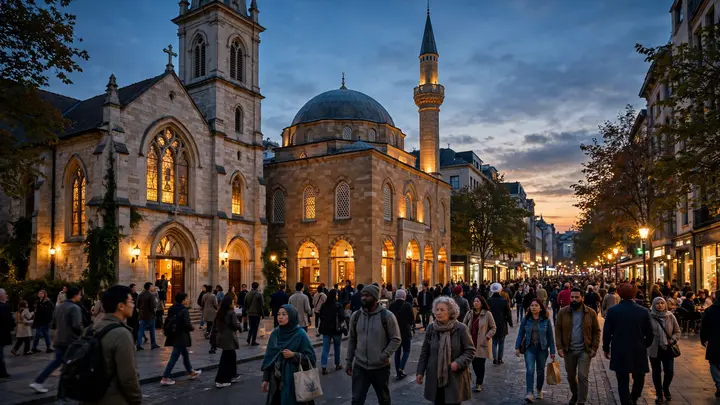
Muslims will outnumber Christians worldwide by 2035 — 2.57 billion to 2.52 billion — according to new projections from the Pew Research Center, ending centuries in which Christianity was the largest religion on earth. The projections were released on 18 November 2026 in Pew's report "The Future of World Religions: Population Growth Projections, 2020–2070".
Nine years. That is how close the crossover is. For two thousand years, Christianity has been the world's largest faith, through empires and reformations, through missions and martyrdoms. Now a demography report says the lead changes hands within a decade — not because Christians are disappearing, but because Muslim families are growing faster.
Pew's senior demographer Conrad Hackett, who led the study, is careful about what the numbers mean. These are projections, not predictions. They assume recent rates of births, deaths, religious switching and migration continue, and they do not model wars, epidemics, revivals or economic shocks. Still, the direction is hard to ignore: the 2015 edition of the same study had the two faiths reaching near parity around 2050. This time, the crossover comes fifteen years sooner.
Pew's 2035 Projection: The Numbers Behind the Crossover
In 2020, Pew estimates, there were about 2.27 billion Christians and just over 2 billion Muslims in the world. By 2035, the report says, Muslims "will exceed Christians both in absolute number and as a percentage of the global population." By 2070, if recent trends continue, there will be more than 3.6 billion Muslims and just under 3 billion Christians. Muslims would rise from 26% of humanity to 36%; Christians would hold fairly steady at 29%.
Print it, pray through it, and share it with your family or small group.
The study covers 201 countries and teritories and was produced with the Centre for Advanced Studies of Population and Religion (CASPAR) in Poland. It is built on national censuses and surveys and looks at seven religious groups across half a century.
But the quieter story inside the report may matter more for the Church: Christianity is not collapsing. Pew expects the number of Christians to grow by about 30% by 2070, to just under 3 billion. Muslims are growing faster, by about 80%, to more than 3.6 billion. The Church is getting bigger. It is just getting bigger more slowly than its neighbour. US Bishops: 64% of Young Catholic Adults Say Faith Matters More Now Than 5 Years Ago found the same kind of surprise closer to home — young Catholics turning toward faith faster than anyone expected.
Why Births, Not Conversions, Drive the Shift
The main reason for the crossover is not conversion. It is births. Between 2020 and 2025, Muslim women had an average of 3.1 children, compared with 2.5 among Christian women, according to Pew. The average fertility rate across all other religious groups combined was 1.6 children per woman — below the replacement level of 2.1 needed to maintain a population without migration.
Religious switching barely moves the global total. Pew estimates both faiths will lose followers to switching between 2020 and 2070, but the losses are far smaller for Islam — around 8 million, compared with an estimated 105 million for Christianity. And 99% of people raised Muslim stay Muslim. The shift is driven by cradles, not conversions: younger populations, larger families, and the simple fact that births outnumber deaths by a wider margin.
That is why the report's authors keep using the same word: projections. Muslim fertility is already falling faster than any other group's, and if birth rates drop faster than expected, the crossover could slip later. Another demographic count, the World Christian Database, puts Christians at about 32.3% of the world in 2026 and sees no crossover before 2075. The future is not settled. But Pew's numbers are the most authoritative count available, and they have moved the date forward by a generation in a single decade. World Watch List 2026: 4,849 Christians Killed for Their Faith, 3,490 in Nigeria shows where much of that Christian growth is happening — and what it costs the people living it.
Christianity's Centre of Gravity Moves South
The report also redraws the map of the faith. By 2070, more than half of the world's Christians are expected to live in sub-Saharan Africa. The Democratic Republic of Congo is projected to overtake the United States as the country with the world's largest Christian population. The faith that began in the Middle East, grew up in Europe, and spread through the Americas is becoming, in numbers at least, an African faith.
The United States tells a different part of the story. By 2070, Christianity is projected to remain the largest religion in America, but Christians may no longer be a majority of the country's population. The same pattern shows across Europe. In Austria, Pew's data projects Christianity falling by 17 percentage points between 2020 and 2070, while Islam climbs nearly 11 points to almost 19% of the population. Latest: France Records 843 Anti-Christian Incidents as Pastors Warn of Hostile Climate reported the pressures French Christians already feel as their country changes around them.
Meanwhile, the world's religiously unaffiliated — atheists, agnostics and people with no religion — are expected to shrink as a share of humanity, from 24% in 2020 to 17% by 2070, even as their numbers rise in several countries. The decline is driven largely by China's falling population, which accounts for a large share of the unaffiliated. Buddhism is projected to fall in both numbers and share, to 2.5% of the world by 2070. Hinduism will grow in absolute numbers but slip as a share, to about 13.6%.
What the Numbers Do Not Say
There is one thing Pew's report cannot do: tell the Church what to do about it. The numbers describe a world in which Christians are more numerous than ever, more African than ever, and no longer the largest faith on earth. They say nothing about whether the faith is alive or dead in the hearts of those 2.52 billion people. A census counts heads. It cannot count hunger for God.
🙏 Did this part inspire you?
That is the question the report leaves hanging over the next nine years. The crossover is coming, on Pew's arithmetic, whether anyone likes it or not. The Church can spend the decade arguing about the count, or it can ask what the count is really measuring — and whether the future belongs to the faith with the most births, or the faith with the most burning hearts. Bible Verses Light Up London's Piccadilly Circus for Global Bible Month showed one answer already glowing in the middle of a world capital: Scripture, in lights, where millions could not miss it.
The 2035 crossover is not a verdict. It is a clock. Nine years from now, the world will count again, and the numbers will say what they say. The only question that matters for Christians reading them today is whether the Church will still be worth counting — not because it is the biggest, but because it is the most alive.
Frequently asked questions
According to the Pew Research Center's report "The Future of World Religions: Population Growth Projections, 2020–2070", released 18 November 2026, Muslims will outnumber Christians by 2035 — a projected 2.57 billion Muslims against 2.52 billion Christians.
The main driver is births, not conversion. Between 2020 and 2025, Muslim women averaged 3.1 children, compared with 2.5 among Christian women. Pew also estimates Islam will lose only about 8 million followers to religious switching by 2070, against about 105 million for Christianity.
No. Pew projects the number of Christians will grow by about 30% between 2020 and 2070, to just under 3 billion. Christians' share of the world population is expected to hold fairly steady at around 29%, while Muslims rise from 26% to about 36%.
By 2070, Christianity is projected to remain the largest religion in the United States, but Christians may no longer make up a majority of the population. The Democratic Republic of Congo is expected to overtake the US as the country with the world's largest Christian population, and more than half of all Christians are projected to live in sub-Saharan Africa.
🙏 Did this part inspire you?
Print it, pray through it, and share it with your family or small group.
🔔 Don't Miss the Next Story!
Get breaking Christian news on your phone before everyone else — allow notifications when prompted, or join our newsletter below!
But the most surprising part of this story is yet to come — keep reading.
🙏 Have a Testimony to Share?
Has God done something amazing in your life? Or want us to cover a specific story? Send your testimony or story request via WhatsApp — your story could encourage thousands!
💬 Comments
Share your thoughts below. Be kind and respectful. If this story touched you, let us know in the comments!