🎧 Listen to This Story (Audio Mode)
Saved for offline reading — text only; photos need the internet.
King Charles Opens General Synod as Archbishop Sarah Mullally Vows to Rebuild Trust
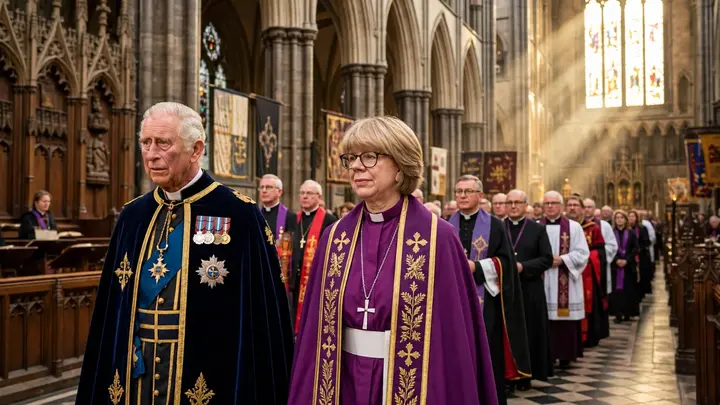
King Charles opened the Church of England's new five-year General Synod at Church House, Westminster, on Tuesday 17 November 2026, after an inaugural Eucharist at Westminster Abbey presided over by the Archbishop of Canterbury, Dame Sarah Mullally. It was the first Synod of the King's reign and the first under Mullally, the first woman to serve as Archbishop of Canterbury.
The King told the Synod that the Church must serve everyone while society feels divided, and he praised the parish system that keeps a church in every community. Mullally set out her priorities: to rebuild trust, to support struggling clergy and parishes, and to present a united face to a divided society.
Two firsts in one morning. A King opening his first Synod. A woman Archbishop presiding over her first Synod. And a Church that knows it has work to do if it wants to be heard in a country that is not sure it is listening any more.
The Archbishop's words were not grand. They were practical. Rebuild trust. Support the clergy who are struggling. Support the parishes that are struggling. Stand together in front of a divided nation. It was the agenda of a leader who knows that trust is not declared, it is earned, one parish at a time.
King Charles General Synod 2026: A New Five-Year Term Begins
Print it, pray through it, and share it with your family or small group.
The General Synod is the Church of England's governing body, and this one will serve for five years. Almost half of its members are new: 47.5 per cent of Synod members are newly elected, which means the room was full of people who had never sat in it before.
That is a lot of fresh faces for a body that has to make hard decisions. New members bring new energy, but they also bring new questions, and the Church will need both in the years ahead.
The day began with the inaugural Eucharist at Westminster Abbey, presided over by Archbishop Mullally. The Abbey has seen coronations and royal weddings and state funerals. On this morning it saw something quieter and, in its own way, just as historic: the first woman Archbishop of Canterbury leading the Church's worship as its Synod opened.
From the Abbey, the Synod moved to Church House, Westminster, where the King formally opened proceedings. As Supreme Governor of the Church of England, the King's presence carried weight. His message was simple and direct: the Church exists to serve everyone, and in a divided society that service matters more, not less.
He also praised the parish system, the network of churches that puts a parish church in every corner of the country. It is one of the Church of England's oldest strengths, and one of its most fragile. Parishes are where the Church meets real life, and they are also where the strain shows first.
Archbishop Sarah Mullally Rebuild Trust: Her Priorities for the Church
Archbishop Mullally's priorities were laid out plainly. First, rebuild trust. The Church of England has been through years in which trust was damaged, and Mullally knows that no amount of fine language will fix it. Trust returns when people see the Church acting with honesty and care, consistently, over time.
It is the place where faith itself has room to breathe, in a country that is not always sure it wants it.
Second, support struggling clergy and parishes. Priests are stretched. Parishes are stretched. Buildings cost money, congregations are smaller, and the work has not got any lighter. A Church that does not look after its own clergy cannot look after anyone else.
Third, present a united face to a divided society. The country is split on question after question, and the Church is split too. Mullally's challenge is to hold the Church together without pretending the disagreements do not exist.
It is a heavy brief for a first Synod. But it is also an honest one. She did not promise quick fixes. She promised work, and she named the work.
The Church of England is not the only church wrestling with trust and unity in a divided age. Bishops in the United States have been working through their own decisions this year, as we reported in US Bishops Approve New Catholic Lectionary Translation for Mass in 196-5 Vote. And bishops in Eritrea have pleaded for peace in a region torn apart by conflict, as we covered in Latest: Eritrean Catholic Bishops Plead for Peace in Horn of Africa in Seek Peace and Pursue It Letter.
Church of England General Synod: What Happens Next
The Synod will meet over the coming five years to debate and decide the Church's direction. The new members will learn the ropes. The old hands will guide them. The Archbishop will lead them. And the King, as Supreme Governor, will watch from a distance that is both ceremonial and real.
What was said on 17 November matters because it sets the tone. A Synod that opens with talk of trust, of struggling clergy, and of unity is a Synod that knows where its problems are. The harder part is what follows: the decisions, the debates, and the long, slow work of rebuilding.
🙏 Did this part inspire you?
Mullally's place in history is already secure. She is the first woman Archbishop of Canterbury, and nothing can take that away from her. But history will judge her on more than a first. It will judge her on whether the trust she spoke about actually returns, and whether the parishes she promised to support actually feel supported.
The King's words will linger too. He asked the Church to hold "the very space for faith itself" in a divided nation. That is a big ask. It means the Church is not just another institution competing for attention. It is the place where faith itself has room to breathe, in a country that is not always sure it wants it.
For now, the Synod is open, the work has begun, and the first woman to lead the Church of England has set out her stall. The next five years will show whether the words spoken in Westminster Abbey and Church House on 17 November turn into something the country can see and feel. Continued tomorrow.
Frequently asked questions
King Charles opened the Church of England's new five-year General Synod at Church House, Westminster, on Tuesday 17 November 2026, after an inaugural Eucharist at Westminster Abbey.
Dame Sarah Mullally is the Archbishop of Canterbury, the first woman to hold the role. The 17 November 2026 Synod was the first under her leadership.
She set out priorities to rebuild trust, support struggling clergy and parishes, and present a united face to a divided society.
47.5 per cent of the General Synod's members are newly elected for this five-year term.
The King said the Church must serve everyone while society feels divided, and he praised the parish system that keeps a church in every community.
🙏 Did this part inspire you?
Print it, pray through it, and share it with your family or small group.
🔔 Don't Miss the Next Story!
Get breaking Christian news on your phone before everyone else — allow notifications when prompted, or join our newsletter below!
But the most surprising part of this story is yet to come — keep reading.
🙏 Have a Testimony to Share?
Has God done something amazing in your life? Or want us to cover a specific story? Send your testimony or story request via WhatsApp — your story could encourage thousands!
💬 Comments
Share your thoughts below. Be kind and respectful. If this story touched you, let us know in the comments!