🎧 Listen to This Story (Audio Mode)
Saved for offline reading — text only; photos need the internet.
Noah's Ark Wood Samples Date to 4300 Years Ago at Durupinar Site in Turkey
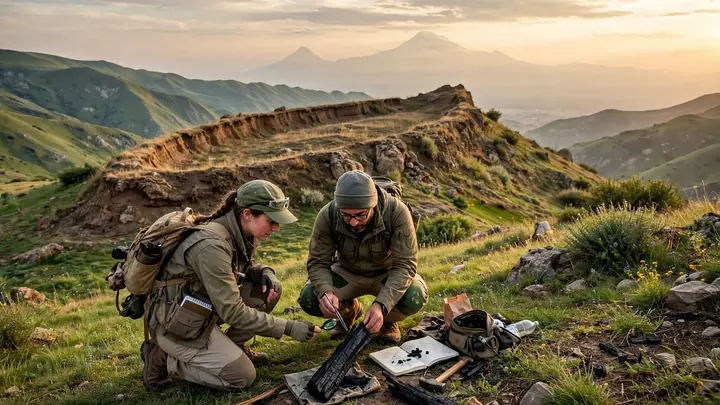
Two charred wood samples dug from the Durupınar Formation in eastern Turkey have been radiocarbon dated to about 4,300 years ago. The result was announced on 18 November 2026 by Andrew Jones, founder of the US-based group Noah's Ark Scans. The first sample dated to 2456–2203 B.C. and the second to 2446–2143 B.C., and the team's two proposed dates for Noah's flood — 2348 B.C. and 2304 B.C. — fall inside both ranges.
Before anyone runs ahead with this, the plain truth has to come first. The findings are preliminary and have not been peer-reviewed. They come from one laboratory in the United States that has not been publicly named, and no independent finding ties these wood fragments to Noah's Ark.
Picture the moment it happened. Professor Cenker Atila of Sivas Cumhuriyet University in Turkey, president of the research project, pulled the blackened fragments out of the ground in August 2026 from about nine metres — thirty feet — down, on the southern slope of the Durupınar Formation.
"I was truly excited the moment I first pulled [the wood] out of the ground and held it in my hands," Atila said. "Since we found it at a considerable depth, I immediately realized that it was unlikely to be something from modern times."
Print it, pray through it, and share it with your family or small group.
The site is a boat-shaped mound near Doğubayazıt in Ağrı Province, some eighteen to twenty miles south of Mount Ararat. Atila says one of the pieces "clearly shows signs of human workmanship" and looks flattened, as though worked with an axe or a knife. That claim will draw the most attention, and also the most scrutiny.
A flattened piece of wood can mean many things. It can mean a tool touched it long ago, or it can mean pressure and time did the flattening on their own. The team has not yet published the kind of detailed evidence that would let outside experts settle that question, and that is exactly why the word "preliminary" matters so much here.
The fieldwork behind the announcement ran from 28 June to 30 September 2026, with about twenty researchers from five countries working the site. The team puts the formation's length at 157 metres — 515 feet — which it equates with 300 Egyptian royal cubits, the length given for the ark in Genesis. For believers who have followed the Durupınar story for decades, that number has always been part of the pull: a boat-shaped mound, the right length, sitting where Genesis 8:4 says "the ark came to rest on the mountains of Ararat."
Noah's Ark Wood Samples: What the Radiocarbon Dates Actually Show
What the dates do show is genuinely interesting, and worth saying plainly. Two samples, tested seperately, both landed in the same broad window — the middle of the third millennium B.C. — and both windows cover the dates the team proposes for the flood. That is not nothing.
If the wood had dated to the Middle Ages, or to the Roman period, the story would be over before it began. Instead the numbers sit where the flood story says they should sit.
But a date is not an identity. Radiocarbon testing can tell us when a tree died. It cannot tell us what the wood was part of, who cut it, or how it ended up thirty feet underground on a Turkish mountainside.
That is the gap Jones himself is honest about. "We don't know how the wood got there," he said — a sentence that deserves more attention than the headline numbers. Wood can reach a place in many ways: carried by water, buried by a landslide, dropped by travellers, or left behind by people who had nothing to do with any ark.
The next steps are already planned. Further testing is pending at laboratories in Switzerland and Turkey, and a final report is due in spring 2027, in late April or May.
Those tests will matter far more than this first announcement, because independent labs checking the same samples — or new samples from the same spot — are how a claim like this either gains weight or falls apart. One lab, unnamed, is a starting point. It is not a verdict.
Durupinar Formation: Natural Rock or the Ark's Resting Place?
The scepticism is not new, and it is not small. Geologists who have studied the Durupınar Formation — among them Lorence Collins and David Fasold, whose work in 1996 concluded the site is a natural formation — have long argued that the boat shape is geology, not carpentry. Mountains make strange shapes.
Water, wind, and time carve rock into forms that look like ships, faces, and animals, and the human eye is quick to complete the picture.
That history is worth remembering, because it cuts both ways. The search for the ark has produced sincere work and sloppy work, careful digs and tourist traps, and the difference between them is usually patience.
🙏 Did this part inspire you?
The teams that lasted are the ones that published their data, welcomed outside eyes, and let the evidence speak slowly. The ones that vanished are the ones that announced too much, too soon.
This team, to its credit, has named its next steps and its timetable. The spring report will show whether the patience is real. And whatever the labs conclude, the questions of faith and evidence will keep being tested in harder places too, as documented in Latest: ACN Persecuted and Forgotten Report Finds Persecution Worsened in 18 Countries.
For now, the story sits where so many faith-and-science stories sit: between a tantalising date and an unanswered question. The wood is old. The dates fit the flood timeline the team proposes.
None of that makes it the ark, and all of it makes it worth watching. The same ancient text that anchors this search has survived far tougher questions than this one, as the display of the Great Isaiah Scroll shows in Great Isaiah Scroll on Full Display in Jerusalem for First Time Since 1968, and as the ongoing debate over end-times signs shows in Bible Prophecy 2026: Israel's Third Temple Altar Ready as Rabbi Claims Daniel Countdown Ends.
When the Swiss and Turkish labs report back next spring, the picture will either sharpen or blur. If the dates hold and the workmanship claim survives expert eyes, the Durupınar story will enter a new chapter — one the whole world will be watching. If they do not, the mound will remain what the geologists have long said it is: a remarkable piece of natural rock in a remarkable place.
Either way, the wood has already done something worth noting. It has reminded us that the oldest questions still pull at us, and that the mountains of Ararat still keep their secrets.
Continued tomorrow.
Frequently asked questions
The two charred wood samples were radiocarbon dated to about 4,300 years ago. Sample 1 dated to 2456–2203 B.C. and sample 2 to 2446–2143 B.C., and the team's proposed flood dates of 2348 B.C. and 2304 B.C. fall inside both ranges.
The wood was found about nine metres (30 feet) underground on the southern slope of the Durupınar Formation, a boat-shaped mound near Doğubayazıt in Ağrı Province, Turkey, about 18–20 miles south of Mount Ararat. Prof. Cenker Atila of Sivas Cumhuriyet University found the fragments in August 2026.
No. The findings are preliminary and not peer-reviewed, and the results so far come from one laboratory in the US that has not been publicly named. Further testing is pending at labs in Switzerland and Turkey, with a final report due in spring 2027.
No. No independent finding ties the fragments to Noah's Ark, and geologists have concluded the Durupınar Formation is a natural formation. Andrew Jones himself said: "We don't know how the wood got there."
The team puts the formation's length at 157 metres (515 feet), which it equates with 300 Egyptian royal cubits, the ark's length in Genesis. Genesis 8:4 says "the ark came to rest on the mountains of Ararat," and the site lies in that region.
🙏 Did this part inspire you?
Print it, pray through it, and share it with your family or small group.
🔔 Don't Miss the Next Story!
Get breaking Christian news on your phone before everyone else — allow notifications when prompted, or join our newsletter below!
But the most surprising part of this story is yet to come — keep reading.
🙏 Have a Testimony to Share?
Has God done something amazing in your life? Or want us to cover a specific story? Send your testimony or story request via WhatsApp — your story could encourage thousands!
💬 Comments
Share your thoughts below. Be kind and respectful. If this story touched you, let us know in the comments!