🎧 Listen to This Story (Audio Mode)
Saved for offline reading — text only; photos need the internet.
Great Isaiah Scroll on Full Display in Jerusalem for First Time Since 1968
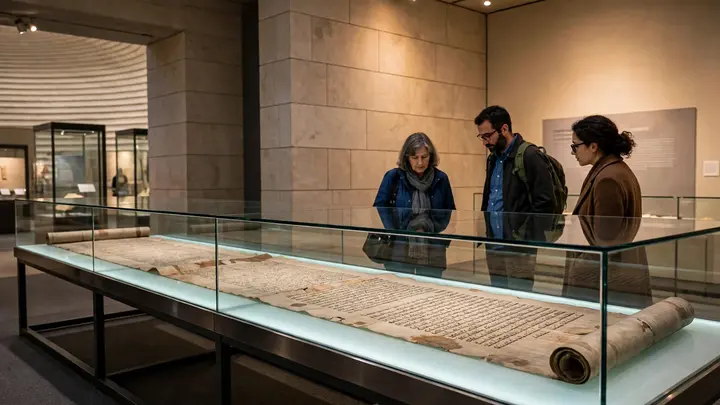
The Great Isaiah Scroll, the oldest complete copy of any book of the Bible, is on full display in Jerusalem for the first time since 1968. The 2,100-year-old manuscript, holding all 66 chapters of the book of Isaiah, is the centrepiece of a new exhibit called "A Voice From the Desert" at the Shrine of the Book in the Israel Museum.
Picture it. A scroll more than seven metres long, unrolled in full under soft museum light, with column after column of Hebrew script flowing across 17 sheets of stitched parchment. The words were copied by hand around 125 B.C., more than a century before Jesus was born, and they read almost exactly like the Isaiah in your Bible today.
That is why this display matters so much. For most of the last six decades, visitors saw only part of the scroll at a time, with the rest kept in the dark to protect it. Now, for a short window, the whole thing is out in the open, all 66 chapters, from the opening call to hear the word of the Lord right through to the final vision of new heavens and a new earth.
The scroll measures seven metres and 17 centimetres, about 23.5 feet, and it is the best-preserved of all the Dead Sea Scrolls. It was found in 1947 in a cave near Qumran, in the Judaean Desert, by Bedouin shepherds who stumbled on clay jars holding ancient manuscripts. The timing still stops people in their tracks: the scrolls surfaced in 1947, one year before the modern state of Israel was established in 1948.
Print it, pray through it, and share it with your family or small group.
Great Isaiah Scroll: All 66 Chapters on Display for the First Time Since 1968
The exhibit marks the 60th anniversary of the Israel Museum and the Shrine of the Book, and the scroll is its crown jewel. Curator Hagit Maoz told CBN News it was a great opportunity to celebrate the anniversary, calling the scroll "the jewel of the crown of the collection of the museum." She explained that the manuscript dates back to the end of the second century B.C., around 120 to 125 B.C., and that it holds all 66 chapters of the book of Isaiah we have today at home.
What makes the scroll so moving for believers is how familiar it is. The text a visitor reads through the glass is, word for word in almost every line, the same Isaiah that Christians and Jews have read for two thousand years. The famous passage about a child being born and a son being given is there. So is the suffering servant of chapter 53, the passage the early church read as a picture of Christ. To stand in front of it is to stand in front of the Bible's own family tree.
The Shrine of the Book itself was built to tell this story. Its white dome was modelled on the lids of the clay jars that held the scrolls, and it sits across a reflecting pool from a black basalt wall, a picture of the struggle between light and darkness described in one of the scrolls. Inside, the scroll is displayed around a raised central drum in a hall kept cool and dim on purpose.
A Voice From the Desert: A Once-in-a-Generation Chance to See the Scroll
This is not a permanent display, and visitors should not assume they can catch it next year. Because parchment is so sensitive to light and to changes in temperature and humidity, the scroll can rarely be shown in full. Museum officials have said it will be presented in its entirety for only four months, and strict conservation rules allow just 25 visitors at a time into the temprature-controlled Scroll Gallery, for ten minutes each.
That limit turns a museum visit into something closer to a pilgrimage. People who make the trip will wait, walk in quietly, and then have ten minutes with a document older than the Roman Empire's grip on Jerusalem. For many, those ten minutes will be the closest they ever come to touching the world of the prophets.
The exhibit also puts the scroll in its wider story. The Dead Sea Scrolls were discovered in eleven caves near the ancient settlement of Qumran between 1947 and 1956, and they include hundreds of manuscripts, many in tiny fragments. The Great Isaiah Scroll is the only complete book among the original finds, and the only complete biblical manuscript ever found so far. The Shrine of the Book also displays the Aleppo Codex, a 10th-century manuscript widely regarded as the most authoritative medieval text of the Hebrew Bible.
Dead Sea Scrolls: Why the Isaiah Scroll Still Speaks Today
For Christians, the scroll is more than an artefact. It is evidence that the words they read on Sunday mornings were already settled centuries before Christ walked the earth, copied with care by scribes who believed every letter mattered. In a season when so much faith content is digital and disposable, a 2,100-year-old manuscript that survived in a desert cave feels like a rebuke and a comfort at the same time.
🙏 Did this part inspire you?
The scroll's return to full display has drawn visitors from around the world, and the interest is not only academic. As we reported in Latest: Global Bible Month 2026 Times Square Launch as 2.2 Million Sign Up for 30-Day Bible Challenge, millions of believers are spending this November reading the Bible together, and the same hunger for the Word is visible in Jerusalem. The Bible remains the most-read book on earth, as the Low-Income Households Most Likely to Give 10% of Income to Church and Charity, State of the Bible 2026 Finds report recently showed, and this exhibit gives that hunger a place to stand and look.
The museum has not said how long the scroll will stay on display beyond the four-month window, and the usual pattern is that the original is rested and a high-quality facsimile takes its place. That means the clock is already ticking for anyone who wants to see the real parchment. The scroll waited in a cave for two thousand years, then in the dark for almost sixty more, and now it is out in the light again, if only for a little while.
One question will follow every visitor out of the Shrine of the Book and back into the Jerusalem sun: after standing in front of words copied by hand before Christ was born, and finding them unchanged, what does it do to the way you read them when you get home? The scroll has survived empires, deserts and darkness, and it is still speaking.
Frequently asked questions
The Great Isaiah Scroll is on full display at the Shrine of the Book, part of the Israel Museum in Jerusalem, as the centrepiece of the "A Voice From the Desert" exhibit.
It is the first time the scroll has been shown in full since 1968. Because the parchment is so fragile, it is usually displayed only in part, and the full display will last only about four months.
The scroll dates to around 120 to 125 B.C., making it about 2,100 years old. It is the oldest complete copy of any book of the Bible ever found.
The scroll measures seven metres and 17 centimetres, about 23.5 feet, and it contains all 66 chapters of the book of Isaiah on 17 sheets of stitched parchment.
The Dead Sea Scrolls were found in 1947 in caves near Qumran in the Judaean Desert, one year before the modern state of Israel was established in 1948. More manuscripts were found in eleven caves between 1947 and 1956.
🙏 Did this part inspire you?
Print it, pray through it, and share it with your family or small group.
🔔 Don't Miss the Next Story!
Get breaking Christian news on your phone before everyone else — allow notifications when prompted, or join our newsletter below!
But the most surprising part of this story is yet to come — keep reading.
🙏 Have a Testimony to Share?
Has God done something amazing in your life? Or want us to cover a specific story? Send your testimony or story request via WhatsApp — your story could encourage thousands!
💬 Comments
Share your thoughts below. Be kind and respectful. If this story touched you, let us know in the comments!