German Evangelicals Ask Jews Forgiveness for Nazi Failures
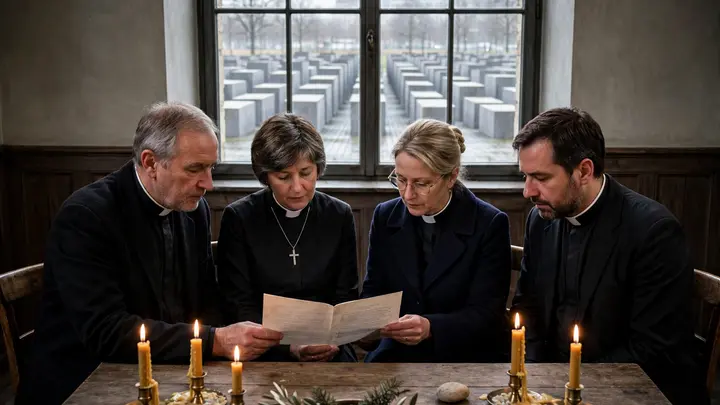
The Evangelical Alliance in Germany has asked the Jewish people for forgiveness for its leaders' support of Hitler and their failure to defend persecuted Jews, releasing an expanded confession on 9 November 2026, the 88th anniversary of the Kristallnacht pogrom. Representatives read the two-page declaration together at a memorial devotional service in the alliance's Berlin office, near the Memorial to the Murdered Jews of Europe.
Picture the scene for a moment. Eighty-eight years after Jewish shops were smashed and synagogues burned across Germany on the night of 9-10 November 1938, a small group of evangelical leaders stood in a quiet Berlin room and read aloud the words their predecessors never said. No crowds, no cameras chasing a spectacle, just a confession spoken where it could be heard.
The timing was deliberate. The alliance chose the anniversary of Kristallnacht, the night the Nazi persecution of Jews turned openly violent, to say what its first postwar confession never managed to say. The date itself was part of the message.
German Evangelical Alliance Confession November 9 2026
The new declaration confronts what the alliance's first postwar confession, issued in 1946, left unsaid. That earlier text spoke in general terms about guilt, but it never named the specific failures that made the guilt real. The 2026 confession names them plainly.
Leading alliance representatives welcomed Hitler's takeover in 1933, the confession admits, expecting political change to return Germany to "God's order". That welcome was not a private opinion held by a few men in a corner. It was the public posture of a movement that believed a strong leader would restore Christian values to a broken nation.
Worse still, the declaration says, those leaders justified anti-Jewish measures with supposed biblical arguments. Scripture was bent to bless exclusion, and then persecution, and the church's own language was used to make it sound righteous. That is the wound the confession tries to name: not just silence, but words spoken in God's name that helped evil along.
The Evangelical Alliance in Germany, known as the EAD, is one of the country's oldest evangelical bodies, and its political representative Johann Matthies commented on the confession in Christian Daily International's report of 10 November. The declaration asks forgiveness for the failures of earlier leaders and for wrongs committed by churches and Christians.
What the 1946 Confession Left Unsaid
Why did it take eighty years to say this? The 1946 confession was written by men who had lived through the war, and it carried the caution of people still sorting out what they had done and what they had allowed. It spoke of guilt in the abstract, which is the easiest kind of guilt to carry, because it never points at a name or a decision.
The new text does the opposite. It names the welcome given to Hitler in 1933, the hope that his rule would restore divine order, and the biblical arguments used to defend measures against Jews. Each of those points is a fact the alliance could have named decades ago, and the confession is honest about that delay, even if it does not dwell on excuses for it.
Confession is not a new idea for German Christians. The country's churches have wrestled with their wartime record for generations, and the wider evangelical movement has its own history of facing hard truths about its past, as seen when believers gather to mark moments of repentance and renewal, like the 15 Baptisms in Brazil: Two Churches Celebrate New Life in Christ. But a confession that names names and decisions, rather than hiding behind generalities, is still rare enough to matter.
The question the declaration raises now is whether confession will lead to changed conduct. Forgiveness asked is not forgiveness recieved, and the Jewish community owes the alliance nothing in return. The test will be what German evangelicals do next, in their teaching, in their politics, and in their friendships with Jewish neighbours.
Kristallnacht Anniversary and the Berlin Memorial Service
The memorial service itself was small and deliberate. The EAD's Berlin office sits near the Memorial to the Murdered Jews of Europe, the field of grey concrete slabs in the heart of the city that marks the scale of the Holocaust. Reading a confession in that shadow was not an accident of geography.
Kristallnacht, the "Night of Broken Glass", saw Nazi mobs destroy Jewish businesses and synagogues across Germany and Austria on 9-10 November 1938. Around 100 Jews were killed that night, thousands were arrested, and the pogrom marked the moment when persecution became open violence that no German could claim not to see. Eighty-eight years later, the alliance chose that night to say sorry for what its leaders did and did not do.
The confession lands in a Germany where antisemitism is rising again, and where Christians who speak up for Jewish neighbours face real pressure. Across Europe, believers are being asked where they stand, whether on hospital wards or in public debate, as French Bishops Tell Catholic Hospitals to Refuse Assisted Dying showed this week. Words spoken in Berlin this November will be measured against actions taken in the months that follow.
For now, the declaration stands as a record: a Christian alliance admitting that its leaders welcomed a dictator, blessed his measures with Scripture, and failed the Jews they were called to love as neighbours. The confession does not undo the past, and it does not claim to. It simply says, at last, what happened, and asks for forgiveness.
What happens next belongs to the living. The alliance has spoken its confession in Berlin, and the Jewish community will decide what it means.
But the words are now on the record, read aloud beside a memorial to the murdered, on the anniversary of the night the glass broke. And that, after eighty years, is something the earlier confession never managed to give.
Frequently asked questions
On 9 November 2026, the 88th anniversary of the Kristallnacht pogrom of 9-10 November 1938. Representatives read the two-page declaration at a memorial devotional service in the alliance's Berlin office.
For its leaders' support of Hitler, including welcoming his takeover in 1933, and for their failure to defend persecuted Jews, as well as for wrongs committed by churches and Christians.
The first postwar confession spoke of guilt in general terms but never named the specific failures: welcoming Hitler's takeover, expecting a return to "God's order", and justifying anti-Jewish measures with supposed biblical arguments.
Johann Matthies, the EAD's political representative, commented on the confession in Christian Daily International's report of 10 November 2026.
At a memorial devotional service in the Evangelical Alliance in Germany's Berlin office, near the Memorial to the Murdered Jews of Europe.
🔔 Don't Miss the Next Story!
Get breaking Christian news on your phone before everyone else — allow notifications when prompted, or join our newsletter below!
But the most surprising part of this story is yet to come — keep reading.
🙏 Have a Testimony to Share?
Has God done something amazing in your life? Or want us to cover a specific story? Send your testimony or story request via WhatsApp — your story could encourage thousands!
💬 Comments
Share your thoughts below. Be kind and respectful. If this story touched you, let us know in the comments!